Tuesday, November 18, 2008

Interview: Stephen Hunt

Every Tuesday, I'll have an interview posted.


Stephen Hunt won the WH Smith New Talent Award in 1994 and now runs SF Crowsnest. The Court of the Air is his latest book, published under Tor in the US, while its sequel, The Kingdom Beyond the Waves, is now available in the UK.

Hi! Thanks for agreeing to do the interview! First off, let's talk about your latest books, The Kingdom Beyond the Waves and The Court of the Air. How long have you been working on this series? What was the inspiration behind the series?

I started writing ‘The Court of the Air’ in 2005, picked up HarperCollins Voyager as publisher in 2006, and saw the novel hit the bookshops in 2007. For the novel, I really wanted to create a page-turning fantasy adventure set against the backdrop of a 18th/19th century level society that would give me more scope for using sword play, u-boats, airships and machine guns than the standard furry-pants-N-elves style fantasy books clogging the shelves.

‘The Kingdom Beyond the Waves’ is the follow-up to ‘The Court of the Air’, although both are standalone novels, albeit sharing some of the main characters. That was a very deliberate decision. I love Bernard Cornwall’s ‘Sharpe’ books, and would personally take an interlinked series like his, over a ‘you have to read the last ten books to get into volume number eleven’-type fantasy series any day.

I basically wanted to write what I’d quite fancied reading, but found depressingly little of on the bookstore shelves (although David Gemmell comes close with his ‘Jon Shannow’ series, as does Frank Herbert with his ‘Dune’ stories).

‘The Court of the Air’ follows two orphans on the run being pursued across the Kingdom of Jackals by assassins and trying to work out why in the world they’ve been targeted, before dragging in the eponymous Court of the Air of the title – a secret society based on a floating zeppelin city looking to control the development of the future by modelling the world on steam-driven computers called ‘transaction engines’.

‘The Kingdom Beyond the Waves’ features a university professor traveling deep into a dangerous jungle by u-boat to find a lost civilization that holds the secret to creating the perfect pacifist utopian society. Inevitably, she discovers that utopia comes at a terrible cost. Well, they always do, don’t they?

At this point in time, do you foresee an "end" to the series or are you more of the mindset that you'll work on the series for as long as readers and publishers will allow you to?

There’s definitely a full-blown space opera or two lurking inside me, but outside of that, I aim to keep expanding the Jackelian fantasy world of ‘The Court of the Air’ and ‘The Kingdom Beyond the Waves’ for as long as it retains my engagement and interest, I think. My role model is the excellent and criminally underrated Trigan Empire series by Don Lawrence (which fans of colourful British comic book art may dimly recall): it always seemed like there was another amazing adventure-packed vista hiding just around the corner and off the side of the map. There are a few corners of my Jackelian map yet to be pushed into, methinks, and some great fun to be had getting there.

What is it about steampunk that appeals to you?

I would argue that I’m writing fantasy with a light blend of science fiction stirred into the mix, rather than steampunk. My Jackelian society is obviously set at a late Georgian/early Victorian technological level, though, so I can see how the label gets applied. For myself, however, steampunk is the proper alternative history jobbie with walk-on parts for Sherlock Homes, Captain Nemo and Queen Victoria. I haven’t, to date, done that - Alan Moore’s ‘League of Extraordinary Gentlemen’ already appears to have that territory well and truly claimed [it].

My last few novels have been far more Moorcock and Jack Vance, rather than the Wild Wild West (I always feel I should precede that now with a wicky-wicky-wicked: thanks, Will Smith), and I’m far happier following in their tail wind without all the faux-‘By Jove, Sir Anthony, tis’ that devil Moriarty I spy’ dialogue. Or, for that matter, the painstaking historical research trying to work out if the hansom cab clocks on a 1865 Lavinia-type model were made by the United Clock Corp of Brooklyn, New York or someone entirely different.

In your opinion, what are the significant changes in your writing style or skill compared to your first novel, For the Crown & The Dragon?

There’s thirteen years between those two novels, so a world of difference for myself as a person. One was written by a kid a couple of years out of college, creating this mad unique thing that was labeled ‘flintlock fantasy’ by the press, the other was written by a cynical, jaded old geezer (well, it feels like it sometimes). Your life changes, your world-view changes, your tastes in reading alter, everything changes.

How did Tor end up being your US publisher? What were the difficulties in originally finding a UK publisher for the book?

It won’t help the morale of budding authors reading this, but I oddly didn’t run into any difficulties. When I decided to do a second novel, John Jarrold – my soon-to-be agent – said he’d take me on as his first client having recently left the book trade as an editor, and he managed to kick off a bidding war on ‘The Court of the Air’ between various British publishers who were biting my arm off to take the novel on.

After HarperCollins Voyager won the UK auction, they then went on to sell the rights to publishers in Japan, Russia, Spain, Portugal, France, Germany, and of course, Tor in the USA. I fully realize this isn’t the standard publishing tale, though – with the piles of rejection letters and the accompanying pain. From zero to international bestseller in ten seconds… it still feels surreal to me sometimes.

Have you written any short stories lately or are novels your current end-goal?

No short stories at all for about eight years. I’ve been approached quite a few times by editors of anthologies to write them, but I’ve regrettably had to turn them all down due to extreme time poverty. I hold down a very stressful day job and it’s a war of attrition to find enough time to devote to my novels, let alone doing shorts, which always take a disproportionate amount of time to write.

What's your writing process/routine like?

A little every day, religiously, fitted in around the day job. Weekends, evenings and holidays are my best buddies! The commute is full of adventure in the Kingdom of Jackals, not a chore.

When did you know that you wanted to be a professional writer? What steps did you take to become one?

My pre-fiction career once involved nearly a decade working at various national newspapers and magazines in the UK as editor, publisher and writer – both online and print work. I happened into that field more or less by accident, as having mastered early desktop publishing software like Quark and Illustrator, I found my technical skills highly in demand… and from that point, more or less naturally moved into a more mainstream publishing career. It was all very accidental, as my college degrees were in marketing/business studies, and later, graphic design.

How have RPGs impacted you as a writer?

Not enormously, to be honest. I used to play a little when I was at High School. At college I graduated to PBM (an early form of MMOG, pre internet), and that led to writing reviews of games for magazines like Flagship and Roleplayer Independent… my first published work. I guess it gave me the confidence that I could write and get material published, which is priceless. Start small, and then work your way up to bigger things.

Do you currently still have time to game? What are/were the games you played?

None. My wife has wisely banned all computer games from the house, too. I’d love to have the time to play something like Eve Online, which looks cracking. D&D, Traveller and the first edition of Warhammer were sadly more my era. Jet Set Willy and Manic Miner on the ZX Spectrum, for the computer gaming side of the hobby. I loved painting and assembling all the Citadel war game figures, too.

Let's move on to SF Crowsnest. What made you decide to purchase ProtoStellar?

It was going to shut down, and knowing the exiting editor/owner (who was moving back to the UAE), I thought it would be fun to take over a SFF zine to practice my then new DTP skills on. Quark 1.0, to be exact.

What made you finally settle on SF Crowsnest as the magazine's title?

SFcrowsnest.com was established back in the early 1990s, and AltaVista was the main search engine everyone used. I thought AltaVista = high-place to get a good view: Crow’s nest = high-place to get a good view. This’ll be the AltaVista for the science fiction and fantasy world on the web! www.SFcrowsnest.com was born!

What was the turning point that made you decide to take the magazine online?

Cost. Each copy of the zine made a loss of something like £300 an issue – that was a year’s basic hosting, without the crippling hassle of distribution. If you build it, they shall come… and in those early days of the Internet, they did.

Is the site self-sustaining? If so, how does it accomplish this?

Sadly not. I usually pay about £3000 a year to keep it going out of my own pocket. Online advertising and affiliate fees are derisory and don’t even cover the cost of the basic bandwidth, let alone all the associated extra software/hardware costs.

What exactly is that you do as publisher? How different is it from the duties of its current editor Geoff Willmetts?

The split these days is that I handle the technical/coding/graphic design issues and do the news editor job (as well as being the sugar daddy paying the bills) – Geoff sits in the book review editor role and handles all the contributors and slush pile etc. We muck in wherever and however, though. We’ve been doing SFcrowsnest.com together now for about thirteen years online, but ironically, we’ve never actually met face-to-face, although we do e-mail each other every day.

What are the current goals of the magazine?

Lose less money...

What was the biggest challenge in running the magazine when it was in print? When it was online?

In print: just getting the damn thing out there and into the shops. Online: trying to develop a technical infrastructure capable of handling 700,000 users and 40 million hits a month without breaking the Stephen Hunt retirement fund.

In your opinion, how has the Internet changed the publishing industry?

Less than you’d think. It’s great for marketing/selling your offline products (aka free e-books to ramp your print sales), but making money out of actually being online? Very hard. Porn, gambling and vertical market information services are about the only areas that can generate cash just from putting content online – for most mainstream publishers and broadcasters, their web sites are just infinitely deep money pits. As for record companies and, increasingly, TV/movie companies, hey, the web just came and ate their lunch… leaving Steve Jobs laughing all the way to the First Bank of iPod.

For the geek question of the day, PC or Mac?

I own a few of both. I used to work for Apple, and we wore T-shirts that read IBM = ‘I should have bought Macintosh.’ That being said, there’s a lot of technical coding stuff that can still only be found on the PC. With Bootcamp, the Windows/MacOS faith wars are a little easier to navigate without getting roasted… the fastest PC in the world just became a Mac.

What advice do you have for aspiring writers?

Write a lot. Read even more (and wider than the SFF genre too, to hone your craft).

How about advice for aspiring magazine publishers?

Take a thousand pounds/dollars that would pay for an absolutely great vacation for yourself, douse it in lighter fuel, then throw it on the bonfire and hope that you’ll find a diamond among the ashes. That’s your chances of getting your money back in the publishing game.

Advice for aspiring SF Crowsnest contributors?

Send those reviews, short stories and articles in, as we’ve got Catholic tastes, zero budget and a really frakking big readership.

Anything else you want to plug?

Well, I’ve just had the beautifully rendered cover back from HarperCollins Voyager for my third book set against the backdrop of the Jackelian milieu – ‘The Rise of the Iron Moon’, due for early 2010 publication in the UK.

The paperback of ‘The Court of the Air’ will be hitting the US later this year via Tor, as will the hardback for ‘The Kingdom Beyond the Waves’ early in 2009.

The paperback of ‘The Kingdom Beyond the Waves’ is, as we speak, also rolling out in the UK for a September 2008 launch.

It still feels like early days to me, but the fantasy books have all been selling well and the critic/fan reaction has been overwhelmingly positive, so what can I say?

Rule Jackelia, Jackelia Rules the Clouds.

Monday, November 17, 2008

November 17, 2008 Links and Plugs

You guys still with me? Anyway...
And for your book plug, let's go for something action-oriented:


Halo: The Cole Protocol by Tobias S. Buckell

Book/Magazine Review: The Year's Best Fantasy and Horror 2008 Twenty-First Annual Collection edited by Ellen Datlow and Kelly Link & Gavin J. Grant

Every Monday, I'll be doing spoiler-free, bite-sized book/magazine reviews.

For me, The Year's Best Fantasy and Horror (YBFH) has been this two-headed beast. On one hand, it's an eagerly anticipated book by people involved in the industry, usually for the summation at the front of the book and the honorable mentions list at the back. The various editors are quite thorough and detailed when it comes to this part. The other aspect is, of course, the story/poetry selection and what will likely attract the casual reader.

So, how does it actually fare? Well, with regards to the first part, there were no disappointments. Whether it's covering some of the highlights of the previous year (and alas, the obituaries) to the various media (comics, movies, and music) in which either fantasy or horror plays a part, the book has it covered. The writing is functional and achieves what it sets out to do.

With regards to the stories and poems, it's a welcome ensemble. I wouldn't say that every story struck me with amazement but there's certainly a lot of noteworthy and terrific stories. Staples from the previous year such as Daniel Abraham's "The Cambist and Lord Iron: A Fairy Tale of Economics" and Ted Chiang's "The Merchant and the Alchemist's Gate" are included (and I think I've praised them enough in previous blog entries and reviews) so that should satisfy even the most critical of readers. There's also terrific work from the likes of Karen Joy Fowler, Nathan Ballingrud, Delia Sherman, Catherynne M. Valente, Joyce Carol Oates, Garth Nix, Terry Dowling, and Kij Johnson to name a few. Having said that, here are my top three stories.

While the anthology opened with a strong and effective piece from Abraham, it is followed by an equally impressive story, "Vampires in the Lemon Grove" by Karen Russell, for entirely different reasons. From the magic-realism elements to the setting details, this is a wonderfully-written piece that not only reinvents vampires for a literary readership but creates powerful images combined with character tension. This was certainly a real gem that could have been easily overlooked by the genre community.

This isn't the first time I encountered Elizabeth Hand's "Winter's Wife" but it's a story that satiates even upon multiple re-readings. Hands attention to detail and characterization rises to the forefront as she creates several larger than life characters that matter to the very human narrator. The build-up is slow, steady, and consistent, making the reading endeavor seamless and pleasant.

Rounding up YBFH is "Closet Dreams" by Lisa Tuttle. The author ensnares you with the illusion of the narrative that slowly builds up on the horror. What I particularly liked about this story is that it's a difficult piece to pull off yet Tuttle succeeds in doing so. It's certainly a refreshing read and dares to be different.

The Year's Best Fantasy and Horror isn't my perfect anthology but it's certainly a terrific one and manages to accomplish so many things in just one book. Stories from Abraham, Chiang, and Russel already pays for the book in my opinion, while the nonfiction section is invaluable. Definitely a must-buy for any serious fantasy/horror fan.

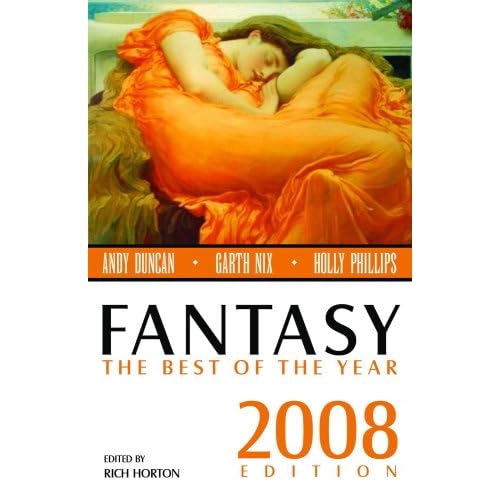
Book/Magazine Review: Fantasy: The Best of the Year 2008 Edition edited by Rich Horton

Every Monday, I'll be doing spoiler-free, bite-sized book/magazine reviews.

This is one of those rare times when I feel I won the lottery twice with one book. First are the stories themselves. Most of the stories were powerful without being too heavy, compelling and can be appreciated on many levels. As a reader, I feel that Horton is in synch with my tastes go as nearly every story left me satisfied. As for the stories that did not earn my unabashed admiration, they're still great stories, although they only work on one level. I found Garth Nix's "Sir Hereward and Mister Fitz Go to War Again" to be an enjoyable adventure story grounded on character for example but it's just that, an adventure narrative that doesn't quite fit other frameworks or multiple re-readings.

The second bonus is that the story selection is vastly different compared to, say, The Year's Best Fantasy and Horror. Yes, there are some overlapping stories such as Daniel Abraham's "The Cambist and Lord Iron" but they're few. Throw in Best American Fantasy 2008 and all three anthologies complement each other with their superior selection of stories that avoids treading on each other's toes. And where else would you see an anthology reprinting a story like "The Teashop" by Zoran Zivkovic, a story which was originally distributed in the UK?

This is one of the tougher anthologies to pick my top three stories as there's a lot of strong contenders. "Light" by Kelly Link stands out as it's as complex piece yet charming when it comes to the language. What I particularly liked about "Light" is that Link doesn't condescend to readers, avoiding the need to explain every detail or nuance but rather letting readers realize it for themselves. The narrative starts out as one thing and ends up something entirely different but it all feels natural and rewarding.

"The Teashop" by Zoran Zivkovic involves amazing legerdemain on the part of the author yet he utilizes simple language and brevity to accomplish his trick. He takes on the "story within a story" motif to new heights and features an ensemble cast of characters that isn't overwhelming yet remains fleshed out.

"The Master Miller's Tale" by Ian R. MacLeod is quite long but remains a compelling narrative. MacLeod's piece depends on characterization and he manages to give his two protagonists a sturdy backbone that feels genuine. I also appreciated the parallelisms it has with the real world and this is one of those stories that works on many levels.

Readers might also want to check out the Introduction as Horton gives a brief overview of the short fiction market and some stories that didn't make it into the book.

Overall Fantasy: The Best of the Year 2008 is one of the best anthologies for the year and easily a must-have, even for fans who've scoured the short fiction market.

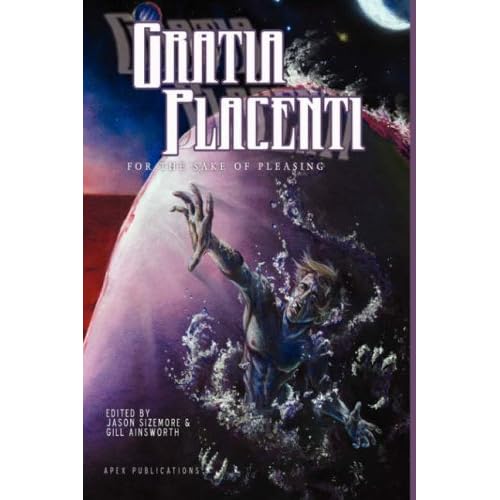
Book/Magazine Review: Gratia Placenti: For the Sake of Pleasing edited by Jason Sizemore & Gill Ainsworth

Every Monday, I'll be doing spoiler-free, bite-sized book/magazine reviews.

I didn't know what to expect with Gratia Placenti and it was a welcome treat despite being a short book at thirteen stories. Horror seemed to be the focus of this anthology and it featured various writers I was previously unaware of.

The first few stories impressed me as this seemed to be the kind of stories I was interested in reading with its development of character and atmosphere. What sold me however were the abilities of the authors to end their stories by implying something rather than directly stating it--making for a reading experience that goes beyond the shocking ending. Later in the anthology however, I also got the other kind of stories, the type that simply attempts to suddenly frighten its readers. That's not necessarily a bad thing and it certainly makes Gratia Placenti a mixed bag but I was really hoping for more of stories that went for the jugular.

Having said that, here are my top three favorites: "Follow the Canary" by Athena Workman dives right into the action and introduces to us this bizarre world and cast of characters. I enjoyed the weirdness of it all and Workman manages to create interesting characters to read. What I really like is the inevitability of the ending which feels natural by the time you reach that point.

Neil Ayres's "The Listening" is another powerful story and relies primarily on characterization and sympathizing with the protagonist. Ayres more than caught my attention and this is one of those stories were the details matter significantly. The ending has that perfect combination of ambiguity and horror/tragedy, depending on how one interprets it.

Last is Mary Robinette Kowal's "Tomorrow and Tomorrow" which is successful because of the atmosphere it sets up. I was lulled into complacency and them wham! Kowal delivers a one-two combination that caught me by surprise and still manages to be effective even if you realize what's coming. The climax is probably the selling point of this story (as opposed to the ending) but Kowal succeeds because of the way she fleshes out her main character.

Overall, half the stories were great reads while the other half were competent. I wished there were more of the former but that doesn't make Gratia Placenti bad. In fact, I'm impressed by the selections of the editors and recommend any horror fan to grab a copy of the anthology. It's just that the first few stories set the bar so high for me that I was prepared to be floored by thirteen excellent stories. Still, no complaints with the other half other than I was expecting one thing and got something else.

Book/Magazine Review: Mythic 2 edited by Mike Allen

Every Monday, I'll be doing spoiler-free, bite-sized book/magazine reviews.

Much like its predecessor Mythic, Mythic 2 feels compact and precise. Both the prose and poetry (and everything else in between) are easy to read and have a lyrical tonality. The anthology is even and consistent, with no sudden drops or spikes in the quality. Editor Mike Allen also continues the format of alternating between both mediums which makes the book work.

For the most part, I found the poems to be decent and the fiction enjoyable. Mythic 2 continues the tradition of weaving or re-inventing fairy tales, legends, and myths all the while infusing it with the sensibilities of the various authors. This isn't a long anthology but the quality for than makes up for it. I really liked all of the prose and appreciated the poetry but I think the former wins out overall, at least in this volume of Mythic.

Particularly striking is Catherynne M. Valente's "Temnaya and the House of Books" which seems to be this amalgam of well-known fairy tales that the author appropriates and transforms into a modern narrative all the while retaining its fairy tale tone and sensibilities. The ending is to be applauded as it is open enough for the reader to wonder at its implications.

Jo Walton's "Post-Colonial Literature of the Elves" is an appropriately-titled poem and makes great use of rhyme without sounding childish, especially considering the subject matter.

Richard Parks's "A Pinch of Salt" is this narrative which strikes an emotional chord as it deals with all too human predicaments and a web of relationships. Characterization and dialogue is easily the author's strength, all the while filling the gaps with conflict. The final line of the story is perfect as it leaves enough room for ambiguity.

Mythic 2 is another fascinating anthology that combines speculative fiction prose with poetry. This is certainly easy to pick up and recommendable to anyone.

Friday, November 14, 2008

2008 Man Asian Literary Prize Won by Miguel Syjuco

From 2008 Man Asian Literary Prize:

A panel of three internationally acclaimed authors and experienced literary judges named Filipino author Miguel Syjuco winner of the 2008 Man Asian Literary Prize for his novel Ilustrado, a fictional account of a young Filipino caught within a notorious scandal spanning over the Philippine history.

The panel of judges for the 2008 prize praised Ilustrado:

"The shortlist for the Man Asian prize testifies to the great vitality of the novel in Asian societies undergoing hectic and unexpected transformations. In the end, we had to choose; and Ilustrado seems to us to possess formal ambition, linguistic inventiveness and sociopolitical insight in the most satisfying measure. Brilliantly conceived, and stylishly executed, it covers a large and tumultuous historical period with seemingly effortless skill. It is also ceaselessly entertaining, frequently raunchy, and effervescent with humour."

The prize winner was announced at a celebratory dinner at The Peninsula Hong Kong. Miguel Syjuco was awarded USD 10,000.

November 14, 2008 Links and Plugs

Been up since 3 am (working on the Philippine Speculative Fiction Sampler -hint- -hint-)...
In the meantime, here's a cool book from Small Beer Press:

Couch: A Novel by Benjamin Parzybok

Podcast Focus: Bear Swarm!

Every Friday, I'll talk about a podcast or two that catches my fancy.

URL: http://www.bearswarm.com/
RSS Feed: http://feeds.feedburner.com/BearSwarm
Description: Podcasts with more than three hosts is difficult to work with but The Bear Swarm! Podcast works for me. Several guys in a game store talk about the games they play (and occasionally plug the sponsored store which happens to give discounts to listeners) which covers everything from mainstream games like D&D to indie games like Dogs in the Vineyard. Sound quality is a notch down from excellent but still quite listenable.

Top 10 Best-Sellers as of 2008/11/9

From USA Today's best-seller list (you can find out their basis here):

  1. Twilight by Stephenie Meyer
  2. New Moon by Stephenie Meyer
  3. Eclipse by Stephenie Meyer
  4. Breaking Dawn by Stephenie Meyer
  5. The Shack by William P. Young
  6. Divine Justice by David Baldacci
  7. Salvation to Death by J.D. Robb
  8. The Audacity of Hope by Barack Obama
  9. Dreams from My Father by Barack Obama
  10. One Silent Night by Sherrilyn Kenyon

My Darwin Awards-Worthy Post for the Day

I just discovered an old essay I wrote on the blog was plagiarized. Just a few lines posted on a message board, nothing worth making a fuss about.

Of course I just want to point out that if you're going to selectively copy-and-paste what I've written, you might as well pick the lines that don't have grammatical errors in it, especially since you're passing it off as your own.

Plug: Philippine Speculative Fiction Sampler

These past few months, one of my projects (together with Mia Tijam) was editing a "virtual anthology" of previously-published Philippine fiction. After hours of reading, soliciting stories, the technical aspects of the site (finding a host, web designer, and artist), coding, and formatting, I'm finally done.

Anyway, if you have the time or are mildly curious about Philippine speculative fiction, check this out:


Philippine Speculative Fiction Sampler (http://philippinespeculativefiction.com) edited by Charles Tan and Mia Tijam

Featuring stories by: Dean Alfar, M.R.R. Arcega, FH Batacan, Douglas Candano, Ian Rosales Casocot, Michael A. R. Co, Khavn dela Cruz, Pocholo Goitia, Francezca C. Kwe, Apol Lejano-Massebieau, and Vincent C. Sales. Cover art by Andrew Drilon.

Thursday, November 13, 2008

November 13, 2008 Links and Plugs

Wrote and posted an essay last night due to the response from the survey (-gasp- people actually read my essays?).
And for your book plug, here's a lazy pun: it never ends.

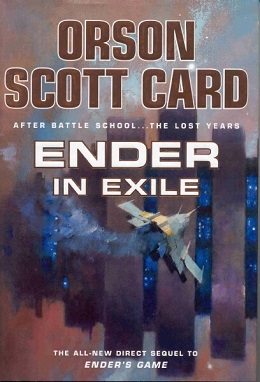
Ender in Exile by Orson Scott Card

2008/11/13 Tabletop RPG Podcasts

Every Thursday, I post links to various podcasts that deals with tabletop RPGs.

Tabletop RPG (Mostly)

General Discussions/Reviews/Everything Else

Interviews
Actual Play Sessions

Wednesday, November 12, 2008

Essay: The Philippines as Science Fiction

Every Wednesday, I'll have an essay or a feature on any topic that catches my fancy!

During Neil Gaiman's visit last year, he quipped that the Philippines was the future, home to flying cars and personal jetpacks. It was certainly a different way of looking at my country and one that I've embraced. The Philippines has a big science fiction following, at least as far as Western TV shows are concerned: Star Trek, Star Wars , X-Files, Battlestar Galactica... if there's a TV show or movie, there's most likely a cult following here. Unfortunately, the same can't be said when things are set in the local setting. Filipinos can talk shop about fortune tellers, duwendes, feng shui, and magical talismans called anting-anting but breach the topic of science fiction and many people become skeptical, especially if you consider the Philippines as a setting. Numerous reasons have been bandies around, from general third-world poverty to a rich history of mysticism, as if the fantastical was in opposition to what is speculatively scientific (which isn't to say there's no science fiction literature or movies being produced). A quick glance though, after distancing myself from what I consider "mundane", I've come to realize that Filipinos are living in what some people would consider a science fiction setting.

If there's any sub-genre that's apt to our plight, it would have to be cyberpunk. Filipinos may be one of the happiest people in the world, yet that doesn't erase the fact that we have many dystopian qualities: we're plagued by both pollution and overpopulation, prominent monopolizing corporations (aside from the telcos, Meralco and PLDT have been around for virtually forever), corruption in the government and the military (the latest fiasco involves officers carrying 105,000 euros in Russia), various influential factions such as the Communist Party of the Philippines and the Catholic Church (whose most recent activity is its attempt to block the reproductive health bill), a history of subjugation by imperialism (that's Spain, America, and arguably Japan), an ignorance of one's own natural resources (did you know the country is home to over 200 endemic birds?), a prominent divide between the rich and the poor, and home to a lot of immigrants (Chinese, Spanish, Americans, Japanese, and Koreans to name a few).

Take a stroll down Metro Manila and you'll find street vendors selling cigarettes by the stick (a pack roughly retails for $0.80 thanks to a lack of anti-smoking levies), fake branded apparel in the malls, the latest pirated DVDs from the US and Asia in semi-hidden stalls (each one retailing under $2.00), call center agents catering to foreign clients (perhaps one of the most absurd instances was when PayPal denied its services to the Philippines: "there's too much credit card fraud in your country but we'll happily employ you to provide customer service for everyone else"), students coding the most potent of viruses (the most famous of which was ILOVEYOU) and programs using pirated software (if not cracking them), manga fans downloading the latest Japanese comics off P2P networks and then translating and distributing them in the same day, and single men and women engaging in cybersex chats or updating their Friendster/Multiply/MySpace/Facebook profiles.

In many ways, the Philippines is a "true" democracy. One vote equals one vote as there's no such thing as vying for seats in this and that state. Philippine elections is a nasty business, whether it's campaigners bribing the masses with money (sneakily inserted into the pockets of the shirts and other items they give away), the deceased suddenly voting, stolen ballot boxes (which is precluded by a brownout in the polling station), and even Miami Vice-style chases (including speed-boat chases and gunfire) for the said ballot boxes. And if Filipinos are unhappy with their elected officials, there's always revolution and People Power (which reads like a magic-realism novel with civilians throwing flowers and rosaries at armed soldiers and actually winning).

For a country that's poverty-stricken, we're this weird paradox of being technologically handicapped (personal computers are considered quite expensive for most people) yet software is prominent (thanks to piracy) and the populace is quite proficient (we have a lot of talented programmers). What's most peculiar is our slow evolution into cyborg culture as mobile phones are becoming ubiquitous to the point that families who have trouble paying their bills nonetheless own one (and there's a growing number of thieves who aren't interested in your wallet but are simply out hunting for cellphones). The second Edsa Revolution was virtually organized via text messaging, and to this day numerous propaganda and bomb threats have spread through the medium.

The nation has also had an interesting set of personalities. One of our more politically active cardinals--now deceased--was named Cardinal Sin. The daughter of a former president became an actress and then a game show host, and somewhere in between had sexual affairs with prominent basketball players and/or celebrities. Former president Joseph Estrada certainly had an interesting career as he got his start with cinema and progressed through the ranks of politics from humble mayor to elected president before he was criticized by the media, held trial for corruption, an attempted impeachment by the public, imprisonment, pardoned, and then heralded as a messianic figure of sorts by the masses.

And then there's the weird event that occasionally crops up, such as inmates dancing in synch to the tune of Thriller.

So the next time a Filipino tells me that the country doesn't have a background of science fiction, all I have to say to them is that I'm not making this shit up.