- The Last Song by Nicholas Sparks
- Eclipse by Stephenie Meyer
- The Time Traveler's Wife by Audrey Niffenegger
- New Moon by Stephenie Meyer
- Breaking Dawn by Stephenie Meyer
- The Shack by William P. Young
- 92 Pacific Boulevard: A Cedar Cove Novel by Debbie Macomber
- Alex Cross's Trial by James Patterson and Richard DiLallo
- Twilight by Stephenie Meyer
- Scarpetta by Patricia Cornwell
Friday, September 18, 2009
Top 10 Best-Sellers as of 2009/9/13
From USA Today's best-seller list (you can find out their basis here):


Thursday, September 17, 2009
September 17, 2009 Links and Plugs
Updating the blog at 2 am probably isn't the smartest thing to do...
And the must-visit site for the week is the Interstitial Arts Foundation: Annex.
Interviews
And the must-visit site for the week is the Interstitial Arts Foundation: Annex.
Interviews
- Resonance FM interviews Cory Doctorow (podcast).
- Mentat Jack interviews Genreville.
- Sue Lange interviews Vonda N. McIntyre.
- Innsmouth Free Press interviews Chelsea Quinn Yarbro.
- Marshall Payne interviews Vylar Kaftan.
- K Tempest Bradford interviews Verb Noire.
- The Dragon Page interviews Alma Alexander (podcast).
- Suvudu chat with David Anthony Durham.
- Jennifer Brozek on Yet Another Reason Why Reading Slush Is Good For Authors.
- Jason Sanford on In the beginning was the word, and the word was "That's life!" Related: Jeff VanderMeer on I WILL Read Your F@#*ing Script…If You Leave Cookies and Milk. Nick Mamatas on Theeeyy'ree GREEAAT!
- SF Signal Mind Meld: What Book Introduced You to Science Fiction?
- Clint Harris on Getting back up to steam (hold the 'punk').
- Margaret Ronald on Getting through the bad patches.
- Maureen Carter on The Hard Sell.
- Rachelle Gardner on Help! An Agent Relationship Gone Bad!
- Marie Brennan on The value of the Bechdel Test.
- Bernie Mojzes on The Moral Ambiguity of Story.
- Pixiu Press submission guidelines.
- Announcing Tu Publishing, and a video challenge.
- Gulf High School IB student, parents object to book.
- Congrats to the winners of the Book Blogger Appreciation Week.
- 100 Best Blogs for Book Reviews.

Wednesday, September 16, 2009
September 16, 2009 Links and Plugs
Today's the opening of the Manila International Book Fair!
And if you need some writing inspiration, you should read Matthew Hughes' (the writer!) keynote speech to the Surrey International Writers Conference. (And congrats to Mr. Hughes for signing with Angry Robot Books).
And not work safe but here's short fiction from Terry Bisson that you can read during your 10-minute break: "Billy and the Circus Girl" "Billy had a little dick. When he rubbed it, it got bigger."
Interviews
- Rose Fox interviews Steven Klotz of MentatJack.
- Jeff VanderMeer interviews Lev Grossman.
- Eric Searlman interviews translator Terry Gallagher.
- RRR FM interviews China Mieville (podcast).
- Jackie Kessler on Making Time.
- Brian Slattery on The Book is Dead, Long Live Books.
- Dean Wesley Smith on Killing the Sacred Cows of Publishing. Agents.
- Kassia Krozser on Digital Publishing: Looking at the Business Model.
- Daniel Menaker on Redactor Agonistes.
- Mortimus Clay on Fantasy World Building.'
- Bruce Baught on GoodReader: Huge advance in PDF handling on iPhone (attention: RPG fans).
- Victoria Strauss on VDM Verlag Dr. Mueller.
- Laura Benedict on The Real Cost of Free.
- Mike Brotherton on Stuff, Experience, and Science Fiction.
- SC Butler on We Are the Orcs.
- Janice Hardy on Moping in the Middle.
- John Scalzi on On The Asking of Favors From Established Writers.
- Nicola Morgan on Appearance + Personality Matters.
- Nathan Bransford on Will Authors of the Future Need Publishers?
- Pimp My Novel on Self-Publishing II: Attack of the POD People.
- Angry Robot Books signs two new authors.
- Harlan Ellison's Dramatic Reading of the Seussified "I Will Not Read Your Fucking Script".
- The Sunday Times EFG Private Bank Short Story Award.
- Chris Barsanti reviews The Complete Stories of J.G. Ballard.

Essay: A Rant on What They Don't Teach You at School
Every Wednesday, I have an essay or feature article on any topic that catches my fancy!
It seems to me that outside of the literary communities, a lot of the glamor and romanticism revolves around authors. For example, we might expect people to say "I want to be a writer when I grow up!" but that's not necessarily the case with other professions in the field such as editors, publicists, agents, and designers. Perhaps the closest thing would be entrepreneurs pursuing the role of the publisher, and artists doing the overall art chores, whether it's book covers or interior art. And when you look at the curriculum of schools and universities (well, I'm not so familiar with the policies abroad), they provide a track for writing but not for these other professions. Not that there's an empirical way to teach "how to become an anthology editor", but neither is the craft of writing reduced to a simple formula (which isn't to say you can't teach the fundamentals, or that the methodology of other professions is simple).
Instead, some of the skills in these "other professions" might be found in other subjects and career paths. For example, a management education--and perhaps some accounting--might prove useful to potential agents and publishers. Editing for me is a misnomer because it can mean anything from proofreading (basic English) to pitching books to publishers (communications? advertising?). Then there's book design, and while there are lessons you can learn from other art-related classes, designing for a print book has its own unique constraints.
Which isn't to say you need a formal degree in order to become successful in one of these fields, any more that you need a Creative Writing degree in order to become a professional author. We're all different and some people benefit from a regimented education system, while others are more inclined to a do-it-yourself and explore-the-world approach. At least speaking from the speculative fiction industry, we have editors, publicists, agents, designers, and editorial assistants rising from all sorts of backgrounds. A lot of what they learned came from first-hand experience working on projects and built their skill-set (and reputation) from there.
To be fair to the academia, they do provide venues to hone these skills, although you're not graded for it (which is both a good and a bad thing, depending on your perspective). For example, there's really little difference between running a high school paper and my duties as a quasi-managing editor (my official title shifts from editorial assistant to managing editor) for a magazine. You still need to coax and convince writers, and they won't submit their articles on time; there'll always be errors in the proofs from the printer and the finished product won't be delivered on time. You'd think just because people get paid (on both sides) the experience would be more efficient but that's not really the case.
And here in the Philippines, some of the professions simply don't exist because the industry is too small. There are no agents for example because fiction writers get paid so low (alternatively, this could also be the reason why we're getting paid so low). There might be a division between marketing, advertising, and publicists but that's probably just one department in the case of local publishers.
Still, don't you wish there's a class that told you "hey, if you're ever going to assemble an anthology, always solicit more stories than you need because your writers will back out at the last moment"? Imagine a lecture from a dream team of editors: Ellen Datlow, Terri Windling, Jonathan Strahan, Gardner Dozois,David Hartwell, Kathryn Cramer, Rich Horton, Jeff & Ann VanderMeer, John Joseph Adams, Martin H. Greenberg, etc.
Tuesday, September 15, 2009
September 15, 2009 Links and Plugs
Check out John Armstrong's interview with literary agent Ginger Clark (podcast).
And Fantasy Magazine is having a 2009 Halloween Flash Contest.
Interviews
And Fantasy Magazine is having a 2009 Halloween Flash Contest.
Interviews
- Rick Kleffel interviews Kage Baker (podcast).
- Rebecca Buchanan interviews Mike Allen.
- Darryl Whetter interviews Margaret Atwood.
- SF Signal interviews Lavie Tidhar.
- Mur Lafferty interviews Jay Lake, Felix Gilman, Jim Kelly, John Kessel, and Pat Cadigan (podcast).
- Suvudu interviews Chris Evans.
- Jeff VanderMeer interviews Caitlin R. Kiernan.
- Karen Healey on Cultural Consultants.
- Angela Slatter on Desirable Characteristics for an Editor (Not to be confused with What Makes an Editor Sexy).
- The Rejectionist on Confidential to Anonymous; Or, Dark Secrets of the Publishing Industry Revealed!
- Jim C Hines on PublishAmerica’s Twittery.
- David Dritsas on E-books catching on with readers.
- Alan Baxter on Reviews and how to take them.
- S. Boyd Taylor On Writing #2: Rewriting -- the Mysterious Process brought to light.
- Natania Barron on Becoming an atheist of the muse.
- Jim Van Pelt on The Fundamental Disconnect Between Young Adults and Young Adults Writing.
- Nathan Bransford on Can I Get a "Ruling": Quotation Marks for Emphasis.
- Daniel Menaker on Redactor Agonistes.
- Keith Oatley on Perspective and Narrative.
Interview: John Joseph Adams (2009)
Every Tuesday, I'll have an interview posted.


John Joseph Adams is the editor of the anthologies Federations, The Living Dead, Seeds of Change, and Wastelands: Stories of the Apocalypse. Forthcoming work includes the anthologies Brave New Worlds, By Blood We Live, The Improbable Adventures of Sherlock Holmes, The Living Dead 2, The Mad Scientist’s Guide to World Domination, and The Way of the Wizard. He is also the assistant editor at The Magazine of Fantasy & Science Fiction.
I guess what appealed to me about Star Trek and Star Wars and the like was the sense of wonder they imparted upon the viewer, and that's one of the reasons they worked effectively as a gateway drug, as sense of wonder is one of SF literature's primary ingredients, so the transition was an easy one to make. There were other influences for me, though--like Robin Cook medical mysteries and Michael Crichton's kind-of-but-not-SF (not SF, because in his stories science is the antagonist)--which all came back to science, and once I realized I liked reading fiction that deals with or is about science, it was a natural progression. It's really at this point that Trek and Wars helped me out, because of their tie-in novels; I, for some reason, had the foolish notion in my head that regular SF novels would read like technical manuals for fictional technologies and/or would be too hard for me to understand.
As to your other points, I'd say the fact that Trek was on TV made it an easy thing to appreciate because watching TV is such a passive activity, and watching an episode will only take an hour, *and* you can do it with your friends. If I recall correctly, I only really started watching Star Trek because my role-playing group friends were talking about it, and had talked about meeting up on Saturday evenings to watch that week's episode. (Note when I say Trek, I'm talking about The Next Generation, which, when I was growing up aired in syndication, on Saturdays; we time-shifted using VCRs and watched them after everyone got off work--well, not me, I wasn't working.) Anyway--I didn't have any previous fascination with space or interstellar societies at that point, so it was really Trek that started that for me. (Star Wars came later for me, really, even though I'd surely seen it at that point, and had toys at some point when I was a kid, but it wasn't something that had shaped my life from the moment I saw it--I actually kind of discovered it anew in my late teens, after Trek put me on this path.)
As for modern gateway drugs, I'm sure TV and film properties still accomplish that same thing to some degree, especially when good movies are made from actual SF novels or stories, or when smart (i.e., not explosions-based) SF films (like Moon, or hopefully District 9, if it's as good as it looks) are released that engage the audience on a level beyond the typical Hollywood blockbuster SF film. But specifically, I'm sure the recent Battlestar Galactica series did a lot to turn more people onto science fiction (even if the finale utterly ruined an otherwise brilliant series and betrayed everything that science fiction stands for).
I'd like to say that comic books/graphic novels also are doing their part, but I'm not sure if it's entirely true--publishers don't seem to advertise in comic books or try to get distribution in comic book stores, so I think the jury is still out on that. But the fact that the graphic novels are always right next to the SF section in bookstores probably means that some cross-over is inevitable.
And finally, I'd say the YA boom we're experiencing right now is one of -- of not the primary -- gateways for young readers. Hopefully when they read some really excellent YA SF novel like Scott Westerfeld's Uglies series, they'll realize that there's more stuff like that in the SF section, or when young Harry Potter readers get a little older and want more stories about wizards, they'll find their way to the fantasy section.
The anthology features a combination of reprints and original fiction. What made you decide to go this route? What are some of the advantages of doing such a selection?
When the book was first conceived, we were going to do a book much like Seeds of Change--i.e., a short (40,000) all-original anthology, in a small hardcover format, which would be intended primarily for sale to libraries and direct order. But Prime Books's distributor, Diamond, wasn't really interested in a book like that, and suggested we do something more like my Night Shade anthologies, Wastelands and The Living Dead, which both sold very well. So, we decided to expand the book to 125,000 words, and incorporate a mix of reprints and originals, and made it a trade paperback intended for traditional distribution.
There are several advantages to putting together a book that way. For one thing, by incorporating reprints, you can get stories by some top, big name writers who you might not be able to get otherwise (since they're quite busy); and the other thing about reprints is that it's generally less expensive to secure reprint rights to stories, compared to the cost of originals. From a creative standpoint, I think it also serves to make a fuller book, in that it can showcase some of the evolution of the theme you're working with; by running stories from 10, 15, or 20 years ago, alongside stories written today, you can get an idea of where the theme or sub-genre comes from and where it's going, in a way that's not possible with an all-original anthology. Another advantage is that it allowed me a lot of flexibility in the original fiction I acquired; because I secured enough "name" writers via reprints (which are necessary for an anthology, otherwise bookstores may not order it in sufficient quantities), I was able to publish stories by a lot of newer writers readers might not be familiar with.
Since this is the second time you're doing an anthology for Prime Books, what lessons did you learn from working on Seeds of Change that you were able to apply here? How about on your other anthologies such as Wastelands and The Living Dead?
Well, one thing I learned from Seeds of Change was to over-invite (necessary, because some people, despite their best intentions, will drop out of the project) even more than I thought I needed to--a lot of folks dropped out of writing a story for that book, more than I anticipated, so I'm fortunate that it turned out as well as it did. Of course, the obvious solution to that predicament is to have an open reading period, which for Federations, I did, and gladly did so; I would have done the same for Seeds too, in fact, but Gordon Van Gelder (my boss at F&SF) thought it might be a bit of a conflict of interest with my duties as assistant editor (and slush reader) at F&SF, since the theme of Seeds of Change was so broad. Because Federations was quite specific, he had no problem with me reading slush for that book, for which I'm grateful, as it made assembling the book much less stressful, and because several pieces from the slush made it into the book.
Lessons learned from Wastelands and The Living Dead? Well, for one thing, the bigger the author, the sooner you should start the process of negotiating permissions. A lot of authors, even quite prominent ones, handle their own short fiction permissions, but several have their agents handle them, and for agents, short fiction is an understandably low priority item (i.e., there's not much money in it for the author, not for a reprint, and even less for the agent). Such delays are understandable, but they can make deadlines scary.
As an editor, what was your criteria in terms of story selection?
For the reprints, I wanted to find great stories by well-known authors, but instead of focusing on their most famous stories, I went looking for ones that were perhaps not as well-known (and not as often reprinted) but are damn good despite that; that way, even though they're reprints, unless you're a voracious reader, maybe they'll be new to you, and thus as good as an original piece.
For the original stuff, I was looking for stories that did something interesting or different with the theme, or made the concepts feel fresh to me. Obviously I wanted to avoid anything that read like Star Trek fanfic with the serial numbers filed off. So there was that, along with the typical anthology selection criteria, which considers variables like balance and thematic variety.
If you would have further reading list of novels for readers of Federations, off the top of your head, what books would you recommend?
The Stars My Destination comes first to mind because it's my favorite novel, even if it's not purely relevant to an interstellar SF reading list; it's not about interstellar societies, but it does have spaceships in it. I'd also mention that it's MIND-BLOWINGLY AWESOME. So, you know, you should read it.
As for more relevant titles, to start with, there's classic series like Dune and Foundation. Lots of stuff by Lois Bujold and Alastair Reynolds and Orson Scott Card and some of the other contributors to Federations. I especially like Robert J. Sawyer's novel Starplex. More recently, Matthew Hughes's recent novel Template is staggeringly good. There really is a great list of books that could be compiled on the subject. Now I kind of wish I had.
How did the Federations come about? Was it a project you pitched to the publisher?
Prime came to me wanting to do another project, having been pleased with how Seeds of Change turned out. We batted some ideas back and forth before settling on Federations; I believe they first suggested the idea, which I immediately seized upon, given my long-time love of the sub-genre. I would have liked to have more time to put the book together, so that I could have given authors more of a window to write stories for me, but once we decided on the theme, we realized it really needed to be done and ready to publish when the Star Trek movie hit theaters, so it was a shorter deadline than was ideal, but we had it in bookstores by the time the movie hit theaters, so the timing worked out.
Since you've worked on both original anthologies and reprint anthologies, which are you more comfortable with? Which do you hope to work more on in the future?
I'd like to work on more all-original anthologies in the future, and more mixed original/reprint, but I enjoy doing all three kinds. They all offer different challenges and rewards. One of the nice things about a big fat reprint anthology like The Living Dead or By Blood We Live is once I line up the big names necessary to sell the book, I have a lot of freedom in filling the rest of the book, and it's fun to hunt down relevant stories in out-of-the-way places. Although you might not think so, reprint anthologies are a lot more work for the editor--to adequately survey any particular theme, there's a vast, vast amount of material to consider, whereas with an original anthology, your reading list is limited to the stories submitted to you, which will no doubt be smaller, even if you have an open reading period. Sure, you might need to work with authors to revise a story, or you might have to deal with people dropping out for various reasons, but the sheer number of hours spent on a reprint anthology--at least for me, so far--has far outnumbered that spent on acquiring and editing original work.
What I appreciate about you is how you market your anthologies, especially the websites you create which feature short interviews and excerpts from the book. How involved are you with the marketing/promotions, and who comes up with these ideas? What techniques in your opinion have been the most effective so far?
I'm glad you and others seem to find the anthology websites useful; it's hard to measure how effective they are, but I figure they can't hurt, and it's always nice to be able to sample before you buy. I believe I decided to do the website for Wastelands on my own, or perhaps it came about as a result of a discussion with my friend and colleague Jeremiah Tolbert, who built and designed that website for me. Later anthologies have all employed a WordPress template customized to the anthology; building a new template for each book proved to be too time consuming and costly (as I can't do that stuff on my own), but what matters most is the content, and the template I've been using is clean and has a nice aesthetic. Basically what happens is, I get Jeremiah (who is also my web host and webmaster) to setup the blank template for me (substituting the default banner with one for the anthology), then I just use WordPress to fill the site with content. (Lately, I've had my interns help me out with this; huge thanks go to Haris Durrani for the work he did on the By Blood We Live and Improbable Adventures of Sherlock Holmes sites.)
As for marketing and promotions otherwise, well, for my Night Shade titles, I'm pretty involved otherwise, as I'm also Night Shade's publicist. (That's not how or why I was able to sell Wastelands, incidentally; they hired me to be their publicist after I sold them Wastelands.)
Aside from Prime Books, you've also worked on anthologies from publishers like Night Shade Books. Could you tell us more about the pre-publication process, such as how do you convince a publisher to pick up your anthology?
For my first anthology, Wastelands, I basically put the whole anthology together on paper before pitching it to the publisher (via my agent, Jenny Rappaport). I wrote up a pitch for the anthology, and included a (mostly) complete proposed table of contents--meaning I basically selected all (or most) of the stories for the book without a contract in hand, so it was an on spec exercise, which very well could have gone nowhere.
Wastelands did spectacularly well, selling much better than anyone would have possibly imagined. So selling my subsequent anthologies was a bit easier. All of the ones I've sold since then, with the exception of The Mad Scientist's Guide to World Domination, came about because the publisher came to me and said, hey, let's do (an or another) anthology; what would you like to do next? What about this theme, or that theme? The Mad Scientist anthology, which I recently sold to Tor, had to sell the hard way--that is, get a bunch of awesome writers to promise to write you a story for it, and then convince a publisher it's commercially viable. That's really hard to do, even when your other anthologies have sold as well as mine have; you know why? Because anthologies are really really expensive to put together, and they usually don't sell as well as novels, so they're a high risk-to-reward product.
On the business-side of things, is working as an anthology editor a sustainable career?
It seems to be for me at the moment; ask me again in 5 or 10 years and I'll have a better answer for you. I'm still new at this, so it's hard to say with any certainty how sustainable it is. Someone told me that based on the success of The Living Dead they expect By Blood We Live will sell a "metric fuck-ton." I'm not sure how many copies that is, but if it's in the same range as The Living Dead, the sustainability thing will start looking pretty good.
How about an update on your current projects: what are you currently working on and what can we expect from the future?
Well, By Blood We Live and The Improbable Adventures of Sherlock Holmes should now be out and available in fine bookstores nationwide. As to the stuff I'm working on assembling now, I'm currently working on The Living Dead 2, which will be a mix of reprints and original fiction; Brave New Worlds, a mammoth reprint anthology of dystopian fiction. I'm also reading for The Way of the Wizard, a mixed reprint/original antho for Prime. And finally I'm doing at least some preliminary work on The Mad Scientist's Guide to World Domination; that book is all-original, and the contributors' deadline is pretty far off, so the amount of work I can do on it at this point is pretty limited, but I'm at least thinking about it off and on, so I consider it a current project.
If you could go back in time, what advice would you give John Joseph Adams of 2 years ago?
I'd tell him to stop wasting time reading novels and read only short fiction, and that when he reads anthologies or collections or magazines, he should CATALOG THEM, identifying their themes and how much he liked them.That would make things easier for current me.
Anything else you want to plug?
Besides my anthologies, you'll also want to check out The Very Best of Fantasy & Science Fiction, out in October from Tachyon; it's a 60th anniversary retrospective, collecting the best of the best stories from the pages of F&SF. It's got "Flowers for Algernon" AND "The Deathbird" in it, which I think of 1a and 1b on the best of all time list, so run, don't walk, etc.
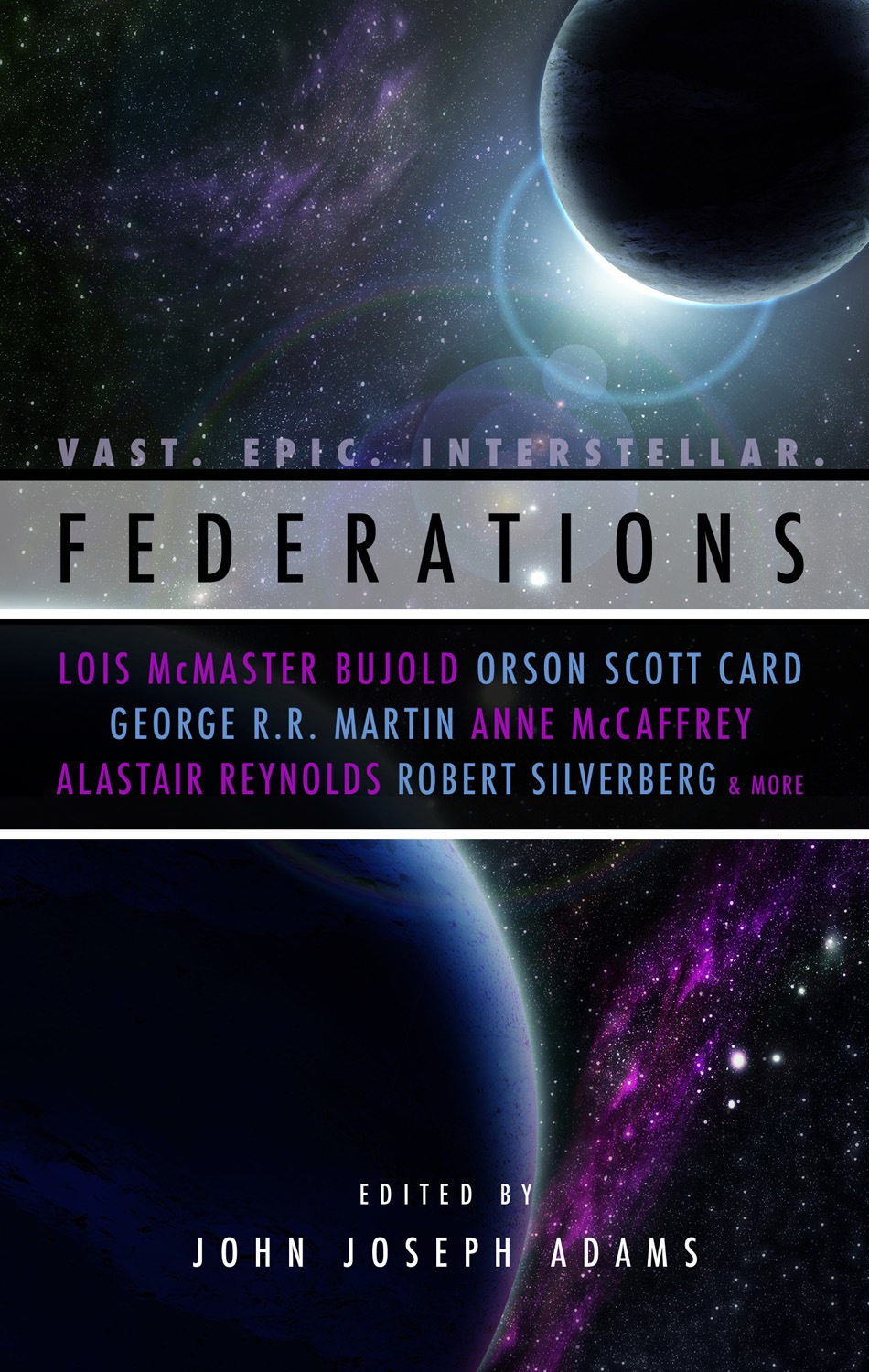


John Joseph Adams is the editor of the anthologies Federations, The Living Dead, Seeds of Change, and Wastelands: Stories of the Apocalypse. Forthcoming work includes the anthologies Brave New Worlds, By Blood We Live, The Improbable Adventures of Sherlock Holmes, The Living Dead 2, The Mad Scientist’s Guide to World Domination, and The Way of the Wizard. He is also the assistant editor at The Magazine of Fantasy & Science Fiction.
Adams also works as a freelance writer. He is currently a blogger for Tor.com, and he has written reviews for Kirkus Reviews, Publishers Weekly, and Orson Scott Card’s Intergalactic Medicine Show. His other non-fiction has appeared in: Amazing Stories, The Internet Review of Science Fiction, Locus Magazine, Novel & Short Story Writers Market, Science Fiction Weekly, SCI FI Wire, Shimmer, Strange Horizons, Subterranean Magazine, and Writer’s Digest.
He received his Bachelor of Arts degree in English from The University of Central Florida in December 2000. He currently lives in New Jersey.
Hi! Thanks for agreeing to do the interview (and being our first return guest!). Let's talk about your recent anthology Federations. In the introduction, you mention how series like Star Trek was your gateway drug into the genre. Why did such series appeal to you? Is it because it was on TV? Or is it due to some fascination with space and interstellar societies? What would you say is one of the modern gateway drugs to SF?I guess what appealed to me about Star Trek and Star Wars and the like was the sense of wonder they imparted upon the viewer, and that's one of the reasons they worked effectively as a gateway drug, as sense of wonder is one of SF literature's primary ingredients, so the transition was an easy one to make. There were other influences for me, though--like Robin Cook medical mysteries and Michael Crichton's kind-of-but-not-SF (not SF, because in his stories science is the antagonist)--which all came back to science, and once I realized I liked reading fiction that deals with or is about science, it was a natural progression. It's really at this point that Trek and Wars helped me out, because of their tie-in novels; I, for some reason, had the foolish notion in my head that regular SF novels would read like technical manuals for fictional technologies and/or would be too hard for me to understand.
As to your other points, I'd say the fact that Trek was on TV made it an easy thing to appreciate because watching TV is such a passive activity, and watching an episode will only take an hour, *and* you can do it with your friends. If I recall correctly, I only really started watching Star Trek because my role-playing group friends were talking about it, and had talked about meeting up on Saturday evenings to watch that week's episode. (Note when I say Trek, I'm talking about The Next Generation, which, when I was growing up aired in syndication, on Saturdays; we time-shifted using VCRs and watched them after everyone got off work--well, not me, I wasn't working.) Anyway--I didn't have any previous fascination with space or interstellar societies at that point, so it was really Trek that started that for me. (Star Wars came later for me, really, even though I'd surely seen it at that point, and had toys at some point when I was a kid, but it wasn't something that had shaped my life from the moment I saw it--I actually kind of discovered it anew in my late teens, after Trek put me on this path.)
As for modern gateway drugs, I'm sure TV and film properties still accomplish that same thing to some degree, especially when good movies are made from actual SF novels or stories, or when smart (i.e., not explosions-based) SF films (like Moon, or hopefully District 9, if it's as good as it looks) are released that engage the audience on a level beyond the typical Hollywood blockbuster SF film. But specifically, I'm sure the recent Battlestar Galactica series did a lot to turn more people onto science fiction (even if the finale utterly ruined an otherwise brilliant series and betrayed everything that science fiction stands for).
I'd like to say that comic books/graphic novels also are doing their part, but I'm not sure if it's entirely true--publishers don't seem to advertise in comic books or try to get distribution in comic book stores, so I think the jury is still out on that. But the fact that the graphic novels are always right next to the SF section in bookstores probably means that some cross-over is inevitable.
And finally, I'd say the YA boom we're experiencing right now is one of -- of not the primary -- gateways for young readers. Hopefully when they read some really excellent YA SF novel like Scott Westerfeld's Uglies series, they'll realize that there's more stuff like that in the SF section, or when young Harry Potter readers get a little older and want more stories about wizards, they'll find their way to the fantasy section.
The anthology features a combination of reprints and original fiction. What made you decide to go this route? What are some of the advantages of doing such a selection?
When the book was first conceived, we were going to do a book much like Seeds of Change--i.e., a short (40,000) all-original anthology, in a small hardcover format, which would be intended primarily for sale to libraries and direct order. But Prime Books's distributor, Diamond, wasn't really interested in a book like that, and suggested we do something more like my Night Shade anthologies, Wastelands and The Living Dead, which both sold very well. So, we decided to expand the book to 125,000 words, and incorporate a mix of reprints and originals, and made it a trade paperback intended for traditional distribution.
There are several advantages to putting together a book that way. For one thing, by incorporating reprints, you can get stories by some top, big name writers who you might not be able to get otherwise (since they're quite busy); and the other thing about reprints is that it's generally less expensive to secure reprint rights to stories, compared to the cost of originals. From a creative standpoint, I think it also serves to make a fuller book, in that it can showcase some of the evolution of the theme you're working with; by running stories from 10, 15, or 20 years ago, alongside stories written today, you can get an idea of where the theme or sub-genre comes from and where it's going, in a way that's not possible with an all-original anthology. Another advantage is that it allowed me a lot of flexibility in the original fiction I acquired; because I secured enough "name" writers via reprints (which are necessary for an anthology, otherwise bookstores may not order it in sufficient quantities), I was able to publish stories by a lot of newer writers readers might not be familiar with.
Since this is the second time you're doing an anthology for Prime Books, what lessons did you learn from working on Seeds of Change that you were able to apply here? How about on your other anthologies such as Wastelands and The Living Dead?
Well, one thing I learned from Seeds of Change was to over-invite (necessary, because some people, despite their best intentions, will drop out of the project) even more than I thought I needed to--a lot of folks dropped out of writing a story for that book, more than I anticipated, so I'm fortunate that it turned out as well as it did. Of course, the obvious solution to that predicament is to have an open reading period, which for Federations, I did, and gladly did so; I would have done the same for Seeds too, in fact, but Gordon Van Gelder (my boss at F&SF) thought it might be a bit of a conflict of interest with my duties as assistant editor (and slush reader) at F&SF, since the theme of Seeds of Change was so broad. Because Federations was quite specific, he had no problem with me reading slush for that book, for which I'm grateful, as it made assembling the book much less stressful, and because several pieces from the slush made it into the book.
Lessons learned from Wastelands and The Living Dead? Well, for one thing, the bigger the author, the sooner you should start the process of negotiating permissions. A lot of authors, even quite prominent ones, handle their own short fiction permissions, but several have their agents handle them, and for agents, short fiction is an understandably low priority item (i.e., there's not much money in it for the author, not for a reprint, and even less for the agent). Such delays are understandable, but they can make deadlines scary.
As an editor, what was your criteria in terms of story selection?
For the reprints, I wanted to find great stories by well-known authors, but instead of focusing on their most famous stories, I went looking for ones that were perhaps not as well-known (and not as often reprinted) but are damn good despite that; that way, even though they're reprints, unless you're a voracious reader, maybe they'll be new to you, and thus as good as an original piece.
For the original stuff, I was looking for stories that did something interesting or different with the theme, or made the concepts feel fresh to me. Obviously I wanted to avoid anything that read like Star Trek fanfic with the serial numbers filed off. So there was that, along with the typical anthology selection criteria, which considers variables like balance and thematic variety.
If you would have further reading list of novels for readers of Federations, off the top of your head, what books would you recommend?
The Stars My Destination comes first to mind because it's my favorite novel, even if it's not purely relevant to an interstellar SF reading list; it's not about interstellar societies, but it does have spaceships in it. I'd also mention that it's MIND-BLOWINGLY AWESOME. So, you know, you should read it.
As for more relevant titles, to start with, there's classic series like Dune and Foundation. Lots of stuff by Lois Bujold and Alastair Reynolds and Orson Scott Card and some of the other contributors to Federations. I especially like Robert J. Sawyer's novel Starplex. More recently, Matthew Hughes's recent novel Template is staggeringly good. There really is a great list of books that could be compiled on the subject. Now I kind of wish I had.
How did the Federations come about? Was it a project you pitched to the publisher?
Prime came to me wanting to do another project, having been pleased with how Seeds of Change turned out. We batted some ideas back and forth before settling on Federations; I believe they first suggested the idea, which I immediately seized upon, given my long-time love of the sub-genre. I would have liked to have more time to put the book together, so that I could have given authors more of a window to write stories for me, but once we decided on the theme, we realized it really needed to be done and ready to publish when the Star Trek movie hit theaters, so it was a shorter deadline than was ideal, but we had it in bookstores by the time the movie hit theaters, so the timing worked out.
Since you've worked on both original anthologies and reprint anthologies, which are you more comfortable with? Which do you hope to work more on in the future?
I'd like to work on more all-original anthologies in the future, and more mixed original/reprint, but I enjoy doing all three kinds. They all offer different challenges and rewards. One of the nice things about a big fat reprint anthology like The Living Dead or By Blood We Live is once I line up the big names necessary to sell the book, I have a lot of freedom in filling the rest of the book, and it's fun to hunt down relevant stories in out-of-the-way places. Although you might not think so, reprint anthologies are a lot more work for the editor--to adequately survey any particular theme, there's a vast, vast amount of material to consider, whereas with an original anthology, your reading list is limited to the stories submitted to you, which will no doubt be smaller, even if you have an open reading period. Sure, you might need to work with authors to revise a story, or you might have to deal with people dropping out for various reasons, but the sheer number of hours spent on a reprint anthology--at least for me, so far--has far outnumbered that spent on acquiring and editing original work.
What I appreciate about you is how you market your anthologies, especially the websites you create which feature short interviews and excerpts from the book. How involved are you with the marketing/promotions, and who comes up with these ideas? What techniques in your opinion have been the most effective so far?
I'm glad you and others seem to find the anthology websites useful; it's hard to measure how effective they are, but I figure they can't hurt, and it's always nice to be able to sample before you buy. I believe I decided to do the website for Wastelands on my own, or perhaps it came about as a result of a discussion with my friend and colleague Jeremiah Tolbert, who built and designed that website for me. Later anthologies have all employed a WordPress template customized to the anthology; building a new template for each book proved to be too time consuming and costly (as I can't do that stuff on my own), but what matters most is the content, and the template I've been using is clean and has a nice aesthetic. Basically what happens is, I get Jeremiah (who is also my web host and webmaster) to setup the blank template for me (substituting the default banner with one for the anthology), then I just use WordPress to fill the site with content. (Lately, I've had my interns help me out with this; huge thanks go to Haris Durrani for the work he did on the By Blood We Live and Improbable Adventures of Sherlock Holmes sites.)
As for marketing and promotions otherwise, well, for my Night Shade titles, I'm pretty involved otherwise, as I'm also Night Shade's publicist. (That's not how or why I was able to sell Wastelands, incidentally; they hired me to be their publicist after I sold them Wastelands.)
Aside from Prime Books, you've also worked on anthologies from publishers like Night Shade Books. Could you tell us more about the pre-publication process, such as how do you convince a publisher to pick up your anthology?
For my first anthology, Wastelands, I basically put the whole anthology together on paper before pitching it to the publisher (via my agent, Jenny Rappaport). I wrote up a pitch for the anthology, and included a (mostly) complete proposed table of contents--meaning I basically selected all (or most) of the stories for the book without a contract in hand, so it was an on spec exercise, which very well could have gone nowhere.
Wastelands did spectacularly well, selling much better than anyone would have possibly imagined. So selling my subsequent anthologies was a bit easier. All of the ones I've sold since then, with the exception of The Mad Scientist's Guide to World Domination, came about because the publisher came to me and said, hey, let's do (an or another) anthology; what would you like to do next? What about this theme, or that theme? The Mad Scientist anthology, which I recently sold to Tor, had to sell the hard way--that is, get a bunch of awesome writers to promise to write you a story for it, and then convince a publisher it's commercially viable. That's really hard to do, even when your other anthologies have sold as well as mine have; you know why? Because anthologies are really really expensive to put together, and they usually don't sell as well as novels, so they're a high risk-to-reward product.
On the business-side of things, is working as an anthology editor a sustainable career?
It seems to be for me at the moment; ask me again in 5 or 10 years and I'll have a better answer for you. I'm still new at this, so it's hard to say with any certainty how sustainable it is. Someone told me that based on the success of The Living Dead they expect By Blood We Live will sell a "metric fuck-ton." I'm not sure how many copies that is, but if it's in the same range as The Living Dead, the sustainability thing will start looking pretty good.
How about an update on your current projects: what are you currently working on and what can we expect from the future?
Well, By Blood We Live and The Improbable Adventures of Sherlock Holmes should now be out and available in fine bookstores nationwide. As to the stuff I'm working on assembling now, I'm currently working on The Living Dead 2, which will be a mix of reprints and original fiction; Brave New Worlds, a mammoth reprint anthology of dystopian fiction. I'm also reading for The Way of the Wizard, a mixed reprint/original antho for Prime. And finally I'm doing at least some preliminary work on The Mad Scientist's Guide to World Domination; that book is all-original, and the contributors' deadline is pretty far off, so the amount of work I can do on it at this point is pretty limited, but I'm at least thinking about it off and on, so I consider it a current project.
If you could go back in time, what advice would you give John Joseph Adams of 2 years ago?
I'd tell him to stop wasting time reading novels and read only short fiction, and that when he reads anthologies or collections or magazines, he should CATALOG THEM, identifying their themes and how much he liked them.That would make things easier for current me.
Anything else you want to plug?
Besides my anthologies, you'll also want to check out The Very Best of Fantasy & Science Fiction, out in October from Tachyon; it's a 60th anniversary retrospective, collecting the best of the best stories from the pages of F&SF. It's got "Flowers for Algernon" AND "The Deathbird" in it, which I think of 1a and 1b on the best of all time list, so run, don't walk, etc.
Monday, September 14, 2009
September 14, 2009 Links and Plugs
I just want to remind Filipino readers that Wednesday is the start of the Manila International Book Fair. Be sure to drop by the Anvil booth to grab a copy of A Time for Dragons edited by Vincent Simbuan (personal plug), Waking the Dead and Other Stories by Yvette Tan, or the upcoming short story collection The Lost Language by Marianne Villanueva.
In other news, Fantasy Magazine is looking for slush readers.
And check out the Mythic Delirium #21 Table of Contents.
Interviews
In other news, Fantasy Magazine is looking for slush readers.
And check out the Mythic Delirium #21 Table of Contents.
Interviews
- This week's Sofanauts guests include Jeff VanderMeer, Mike Allen, and Jeremiah Tolbert (podcast).
- Sanford Allen interviews David Liss.
- Annalee Newitz interviews Jeremy Lassen.
- The Box Room Podcast interviews David Devereux.
- Odyssey Workshop interviews Scott H Andrews.
- Fantasy Literature interviews Leanna Renee Hieber.
- Opinionated? Me? interviews Kaaron Warren.
- David Steffen interviews Jordan Lapp.
- Nick Mamatas on Everyone else is linking it, why can't I? Related: Jason Erik Llundberg on I will not publish your book.
- Rod M Santos On the Crossed Genres ad, and homophobia in general.
- James A Owen on Mapping the Imagination – A Preamble, Part I.
- Jonathan Lethem on Poet of Desolate Landscapes (JG Ballard).
- Jim C Hines on Self-Publishing Myths.
- Cheryl Morgan on LGBT Rights: the Good and the Bad.
- Charlie Jane Anders on How Do You Get Science Fiction To Have "Book Club Lit"?
- Josh Jasper on This Is Sort of Like Having a Luddite Review the New iPod. Related: Jeff VanderMeer on Evil Monkey on Fantasy.
- Cherie Priest on Steampunk FAQ.
- Daily Kos on Mozart and copyright.
- Norman Spinrad on The Folk Of The Fringe.
- CL Anderson on The Writing Life - Starting Over.
- Vonda N. McIntyre on Pitfall #13: Size Matters!
- Editorial Anonymous on Submissions and SASEs.
- Kelly McCullough on Self-Promoting Authors Anonymous.
- Bill Lindblad on Musings from the Road.
- Nicola Morgan on Big Mistake 3: Over-Writing.
- The Intern on what is and isn't a book promotion plan.
- Changes Afoot at Amazon's Search Inside the Book?
- YA writers: Detroit public school teacher of blind kids wants your ebooks for her Braille printer.

Book/Magazine Review: Night's Master: Tales from the Flat Earth: Book One by Tanith Lee
Every Monday, I'll be doing spoiler-free, bite-sized book/magazine reviews.
 The speculative fiction field is quite diverse but because of this, there's also a lot of old books that never get read. Thankfully, there are publishers like Planet Stories that go out of their way to reprint a genre--such as pulp--that aren't in fashion. In the case of Night's Master: Tales from the Flat Earth, it is Norilana Books which reprints this title but unlike Planet Stories, there's a solid link between this book and the type of fiction the publisher, Vera Nazarian, writes (mythpunk). And that's what impressed me the most: Night's Master: Tales from the Flat Earth is old--first published in 1978--and while there are elements that make it dated, it's also progressive in the sense that we can see its influences on today's writers, from Vera Nazarian to Catherynne M. Valente. This is, to me, proto-mythpunk, in the same way the New Wave paved the way for the New Weird.
Tanith Lee's writing style is going to be a hit or miss (and this becomes evident in the first few paragraphs), mainly because of the tone she's going for. It's everything your writing instructor told you not to do: show, don't tell; info dumping; too much exposition; two-dimensional characters; too much contrived coincidences. Taken in isolation, these are practices you don't want to include in a story (at least most of the time). Here, however, there's a purpose to their inclusion. Lee is attempting to mimic the tone of the mythical and the legendary, perhaps a bit too faithfully, thus the writing feels archaic. Similarly, such tales frequently include Romantic elements, hence the lack of variation in the characterization and the frequent intrusion of fate.
And yet, within the framework Lee is working with, she also subverts it. For example, a trope of such narratives is the rewarding of good deeds but here, that's not necessarily the case. Good acts can lead to terrible outcomes, and evil characters might end up doing good. There's also an acknowledgment of differing morals: demons are considered evil by man because the former have different mores from the latter. Mind you, all of this in a book that was published years before I was born.
There's one element that modern readers will appreciate and it's the way Lee structures the book. Night's Master: Tales from the Flat Earth reminds me of the mosaic novel because it's filled with disparate stories that can stand on their own but collectively reveal a larger tapestry. There are three "books" here, each book divided into two parts, and each part divided into three (following a three-act structure). The three books seem unrelated to each other, save for the fact that they have a recurring antagonist, the demon Azrharn (the Night's Master in the title). Each part has a closer association with each other, usually the first part being an origin story but each part can stand on their own. To some, this all might seem simplistic but the way Lee weaves them and interconnects them is to be applauded. Perhaps the closest approximation here is imagine a book collecting all the stories of a symbolic deity like Anansi the Spider, and providing a unifying and coherent framework to understand the narratives.
It's understandable if Lee's writing doesn't appeal to some readers, especially with the simplistic flow of Night's Master: Tales from the Flat Earth, but if you're looking for something experimental or enjoy a romantic, mythical story, then you might want to give this book a try. This is a title that's ahead of its time, and three decades down the line, still holds up to what the author intended it to do.
Book/Magazine Review: Billy's Book by Terry Bisson
Every Monday, I'll be doing spoiler-free, bite-sized book/magazine reviews.
 In many ways, Billy's Book is this weird animal and it's understandable if it polarizes readers. The book collects Terry Bisson's "Billy" stories--flash fiction using a young adult tone that recounts the adventures of Billy. Each piece can stand on its own but when reading them all in one sitting, it becomes evident how Bisson builds upon the previous stories in an absurd continuity not dissimilar from the cartoon comedy South Park.
Perhaps the biggest argument against this book is its simplistic plot but that in itself is deceptive. While there's no denying the relative lightness of each story, it's also a venue for Bisson to showcase his other talents. His dialogue, for example, remains compelling and upbeat, sustaining the narrative and there's something bizarre and funny when repetition comes into play.
There's a gradual progression in Billy's Book. The first story, "Billy And The Ants," for example, features Billy, his mom, and the ants. Later on, the cast evolves to Billy, his mother, his father, and the "guest-of-the-week", which might be anyone from his neighbor to a talking plant. It's remarkable how Bisson makes the continuity work--you have to read it to understand what I mean--and how he keeps it fresh each time.
The stories in Billy's Book actually make good use of formula and subvert what one expects in a children's story. In certain ways, this is the perfect length for PS Publishing because I don't know how long it would have sustained my interest had the collection been novel-length but as it is, it's a memorable novelty.
Book/Magazine Review: The Language of Dying by Sarah Pinborough
Every Monday, I'll be doing spoiler-free, bite-sized book/magazine reviews.
 In the introduction to this book, Graham Joyce makes a daring statement: "This is writing in another league: honest, courageous, startling and absolutely lucid." This is, in reference, to the formulaic horror stories out there, whether it's by other authors or by Sarah Pinborough herself. And yet, upon reading the first chapter, I can't help but agree. While there are traditional elements of storytelling in play here (the father's sickness, for example, is an excuse to talk about the rest of the family), a lot of it feels fresh.
There's the language for example. Pinborough uses the first-person perspective to tell an honest yet haunting biography. She slowly pulls us in and as soon as we grow acclimated to the "you" in the story, we've also been indoctrinated into the vocabulary of the narrator. There are several characters in the narrative and they all come to life in the hands of Pinborough, perhaps not fully explored but hinted enough for us to make our own generalizations. At first glance, there's a sense of selfishness in the narrator that makes it seem like everyone else is flawed and corrupted, but this paves the way for the revelations at the end.
But the real beauty of The Language of Dying, in my opinion, is that this is horror that makes the most out of the genre, the type that crosses boundaries without being overtly so. Related to this is the cover art. I feel that at worst, it spoils the narrative, or at best sets unfair expectations on the reader. Still, Pinborough's style is so different that readers might discard those notions entirely and simply be hooked by the narrative.
Friday, September 11, 2009
September 11, 2009 Links and Plugs
I'm short $150.00 but I have a new LCD monitor (was using a CRT before) so now if only my Internet connection will hold up...
Also, I get a new bi-weekly column over at BSC Review (I'm no Hal Duncan though). This week's column is Speculative Fiction - The Genre without Limitations.
And as far as new releases go, check out Beneath Ceaseless Skies.
Advice/Articles
Also, I get a new bi-weekly column over at BSC Review (I'm no Hal Duncan though). This week's column is Speculative Fiction - The Genre without Limitations.
And as far as new releases go, check out Beneath Ceaseless Skies.
Advice/Articles
- Juliette Wade on How Syntax Can Help You!
- SciFi Wire on Cyberpunk, steampunk and now stitchpunk? Your guide to 11 sci-fi punks.
- Jay Lake on Finding time to write.
- Victoria Strauss on Writers’ Myth: “You Have To Know Someone”.
- Mary Pearson on What YA Lit is and isn’t.
- Kassia Krozser on How I Spent My Summer Vacation.
- Margaret Ronald on Genre dilettante.
- Josh Catone on 5 Rules for Better Web Writing.
- Maria Schneider on Smart Money Answers for Writers.
- Kristine Kathryn Rusch on Setbacks Part Two.
- Janice Dunlap on One Thing Leads to Another.
- Jeanie Franz Ransom on Are You a Goal Maker or a Goal Keeper? Here’s How to Be Both.
- Josh Olson on I Will Not Read Your Fucking Script.
- Nathan Bransford on Introducing Jacob Wonderbar.
- John August on Last Looks.
- JK Rowling and Stephenie Meyer to get comic-book biographies.
- Debut Novel Wins The Age Book of the Year Award.
Top 10 Best-Sellers as of 2009/9/6
From USA Today's best-seller list (you can find out their basis here):
- Catching Fire by Suzanne Collins
- 92 Pacific Boulevard: A Cedar Cove Novel by Debbie Macomber
- Eclipse by Stephenie Meyer
- Alex Cross's Trial by James Patterson and Richard DiLallo
- The Time Traveler's Wife by Audrey Niffenegger
- A Good Woman by Danielle Steel
- New Moon by Stephenie Meyer
- Dark Slayer by Christine Freehan
- Scarpetta by Patricia Cornwell
- Breaking Dawn by Stephenie Meyer
Thursday, September 10, 2009
September 10, 2009 Links and Plugs
You may not get much updates from me in the next few days. The computer monitor at home suddenly died and in its death throes made large static noises as well as the smell of burnt plastic.
In the meantime, readers might want to check out Apex Vol. III, Issue III.
In other news, Flash Fiction Online rejects Crossed Genre's LGBTQ ad.
And in case you happen to be in the area: An Evening of readings from Poe: 19 New Tales Inspired by Edgar Allan Poe at the Montauk Club.
Interviews
In the meantime, readers might want to check out Apex Vol. III, Issue III.
In other news, Flash Fiction Online rejects Crossed Genre's LGBTQ ad.
And in case you happen to be in the area: An Evening of readings from Poe: 19 New Tales Inspired by Edgar Allan Poe at the Montauk Club.
Interviews
- Off the Shelf interviews Tobias Buckell (podcast).
- Q&A at World with the Writing Excuses gang and Mary Robinette Kowal (podcast).
- Rick Kleffel interviews Elizabeth Lynn (podcast).
- Blog Critics interviews PN Elrod.
- The Willpower Engine interviews Nancy Fulda.
- SF Signal Mind Meld on Bad Guys We Love to Hate: The Best Literary Villains in SF/F/H.
- Tola Onanuga on Why District 9 isn't racist against Nigerians.
- Larry Nolen on Trying to grasp a muddled understanding of a review.
- Betsy Tobin on Fantasy: Violation of the Possible?
- Rachelle Gardner on More on Advances.
- Juliette Wade on Designing an Alphabet or Writing System.
- The Book Publicity Blog on Embargoed books, or why book publicists have white hairs.
- Angry Robot Books signs Ian Whates.
- Microsoft Entertainment looking for a writer.
- SMOFCon Scholarship Offered by SFSFC.
Wednesday, September 09, 2009
September 9, 2009 Links and Plugs
As far as personal projects go, I've managed to upload two new articles at the Nebula Awards Blog: My interview with Ysabeau S Wilce and Sheila Finch's review of District 9.
Local writer Paolo Chikiamco has a new site, Rocket Kapre, and features an interview with local writer Kate Aton-Osias (or whatever variation she goes by these days) and a round table discussion on people's favorite Philippine speculative fiction story.
In the rumor corner, it seems that the short-list of winners in the Fully Booked Graphic/Fiction Awards are slowly being informed but I have no reliable sources yet to confirm this.
And GenreVille is Looking for A Few Good Artists.
Interviews
- The Nebula Awards interviews Ysabeau S Wilce.
- Powell's Books interviews Chelsea Cain.
- The Guardian profiles Iain Banks.
- Rick Kleffel interviews Marta Randall (podcast).
- The Dragon Page interviews S.M. Sterling (podcast).
- Radio Drama Revival on How to Record Radio Drama with Skype (via SFF Audio).
- Jeff VanderMeer on Writers: Are you a Face-hugger, a Grub, a Maggot, Godzilla, or What?
- Josh Jasper on Happy Labor Day!
- Dean Wesley Smith on Killing the Sacred Cows of Publishing: Rewriting.
- David Forbes on All Tomorrows: The Demolished Man.
- Jim C Hines on Why Linkbacks are Better than Reposting.
- Rose Fox on How Not to Get Published.
- Kyle M on Five "It Could Happen" Ways to End the World: or at least civilization as we know it.
- Maria Schneider on Editor Unleashed 25 Best Writing Blogs 2009 (Go Moonrat!).
- Rachelle Gardner on Maybe You Shouldn't Quit Your Job Just Yet.
- Juliette Wade on A different value: water.
- The Intern on scientific proof that publishing a book won't make you happier.
- The Rejectionist On Rejection.


Essay: Promoting Philippine Speculative Fiction to an International Audience
Every Wednesday, I have an essay or feature article on any topic that catches my fancy!
For some people, I'm the go-to guy when it comes to Philippine speculative fiction. If you want my motivation for doing so, you can read about it here. What I want to talk about, however, is my methodology.
I want to begin by stating that I didn't plan on promoting Philippine speculative fiction. It honestly started with me wanting to send books to author and editor friends, as well as getting them to read my fiction. And at that time (and probably still is), physical artifacts (i.e. a dead-tree book) is more favorable when it comes to getting the attention of editors and publishers. (Here's a hypothetical scenario: imagine running into an author/editor/publisher and do you think they're more susceptible to read your work if you give them a link or offer them an actual book? Chances are, it's the latter unless they specifically request for the former and in my experience, a lot of publicists--assuming they have the resources to do so--practice this.) From the very start though, promoting my own work to the international scene (and let's face it, a good chunk of the international scene is the US and Europe) presented its own unique challenges, at least in contrast to an aspiring writer living in America.
The first problem I encountered was this: it's expensive to ship books to the US.
If it weren't for this fact, I probably wouldn't be promoting Philippine speculative fiction in the first place. How expensive is it for me to ship books internationally? This article compares the standard of living in the Philippines and suffice to say, I'm no millionaire (I still live with my parents for example). Related to this is the fact that the local post can be unreliable (well, if you imagine first-world postal services to be inconvenient, it's much much worse in a third-world country) so I ended up using a courier service like Fed-Ex. When using such services however, there's a minimum weight that they're charging so whether I'll be shipping one book or three, it's still costing me the same amount of money.
This is where my cheapness kicks in: if sending three books is costing me the same as sending one book, why not the former? And due to this discrepancy, shipping costs more than the actual books. This would have been a great marketing opportunity for me had I been a prolific writer but the reality is I'm not. It was only in 2007 that I got a short story published locally so I couldn't really bombard editors with my work. What else could I send them but the fiction of my fellow writers, even if they'll never reimburse me for the books or thank me (or are even aware that I'm sending their books to other people).
You'll notice that I planned to send books to editors (specifically Gavin Grant, Kelly Link, and Ellen Datlow of The Year's Best Fantasy and Horror fame). Why not, say, book reviewers? This is the second problem with promotion: books on Philippine speculative fiction aren't available abroad.
Theoretically, you send books to reviewers so that they get reviewed and then readers go out to buy the book. In the case of the Philippines, that's a ludicrous goal simply because the books aren't being sold outside of the Philippines. Instead, my target was to spread awareness of local fiction. And how do I accomplish that? I was hoping that editors might reprint (or failing that, at least get mentioned somewhere in their books) the said stories. It was a bonus that when the said editors do praise such stories, it provides encouragement to local writers. Of course this isn't the only way of promoting Philippine speculative fiction, but I'm a writer and this was one of the avenues that was important to me. It's not so much about book sales but recognition by the international scene. Nor was I the only one doing this. Dean Francis Alfar was mailing copies of his anthology series, Philippine Speculative Fiction, to his writer friends and editors, and I was merely following in his footsteps.
In this, both Dean and I had modest success. While no stories were reprinted in The Year's Best Fantasy and Horror, a couple did make to the honorable mentions list. That felt good but ultimately, we also run into the same problems as the books not being available abroad. So the stories get mentioned in the appendix. What happens next? What if a foreign reader is interested in reading about speculative fiction or finds a story mentioned in The Year's Best Fantasy and Horror? Where can they turn to?
This was a dilemma I deliberated on for several days and of course, you had to bear in mind that any solutions I come up with had to be funded with third-world income. No one else in the Philippines was going to promote local speculative fiction aside from Dean and he was focused more on marketing it locally (which is just as well since I'm a nobody here). Taking to heart the adage "be the change you want to see," I went about creating the Philippine Speculative Fiction Sampler. Not feeling too confident with my own skills, I enlisted the aid of a co-editor (Mia Tijam) and after a few month's worth of reading, deliberation, and debate, I managed to put up the site.
Thankfully, the speculative fiction community was open to the project. People like K Tempest Bradford and Nalo Hopkinson for example are open to promoting fiction of other cultures (and genders and beliefs). I thought that my job would be over but apparently it was only the start. There's been a steady interest in the writings of other countries and since I was the person most available publicly (at least on the Internets) when it came to Philippine speculative fiction, I was asked to contribute articles here and there, such as for the Shine Anthology website, or consulted privately for some projects.
An example of this is the upcoming The Dragon and the Stars anthology to be published by Daw in 2010. The editors, Derwin Mak and Eric Choi, were looking for ethnic Chinese writers and when they asked me to contribute, I also recommended other Filipino-Chinese writers that they might not have heard of. Thankfully, the people I recommended agreed to contribute and some of the stories they submitted were up to par to the standards of the editors.
It probably would have been more difficult to promote Philippine speculative fiction if we lacked writers, or if a bunch of our output was crap. Hopefully, that's not the case, and it'll remain that way. In the meantime, I should get back to my own writing...
(Oh, and here's a recent anthology that includes a Filipino contributor, Gabriela Lee):
Subscribe to:
Posts (Atom)