- Asking the Wrong Questions tackles The Del Rey Book of Science Fiction and Fantasy, and one of her complaints is how it lacks stories from first-time authors. Ellen Datlow chimes in with her own response.
- Neil Clarke has created World Fantasy Bittercon for those not able to go to the upcoming convention.
- Edward Champion chimes in on the fall from grace of Harriet Klausner in Amazon.
- Jim C. Hines shares his thoughts on the bookstore chain/independent bookstore divide.
- BookEnds, LLC talks about the reasons behind An Agent's Track Record.
- Andrew Wheeler debunks The Halcyon Science Fictional Days of the Eighties.
- Jo Walton asks What Stops You From Buying a Book?
Monday, October 27, 2008
October 27, 2008 Links and Plugs
It's been a busy weekend (filled with an intermittent Internet connection). On a side note, Jeff Vandermeer has some pretty pictures of some books I sent him. Anyway, here are the links for the day:


Book/Magazine Review: Mythic edited by Mike Allen
Every Monday, I'll be doing spoiler-free, bite-sized book/magazine reviews.
 While a relatively short anthology, what Mythic lacks in quantity is more than made up for with the quality of its selections. Each poem and story stands out as well as fitting the "mythic" tone the book is attempting to capture.
Right from the very start, I was already enamored by the opening poem, "Syllables of Old Lore" by Vandana Singh. One would think that the flow and beat of the anthology would peter out by that's not the case. Allen keeps the interest consistent all throughout.
There are some editorial choices I'd like to highlight. The first is the sequencing. The poems alternate with the short stories and if you're like me who reads anthologies in the sequence they're presented, this formula works. I can imagine my interest waning if I was barraged with poems initially followed by short stories and vice versa. As it is, Mythic gives readers enough time to digest and appreciate the poem that preceded it before moving into short story territory. The alternation plays off one another, keeping the reading experience refreshing. Admittedly, the length of the book (under 200 pages) also plays a crucial role in this and I don't know how better Allen would have fared had he used more material. Mythic is the type of book that you can read in one sitting keeping you mesmerized all throughout.
The second item worthy to note is that Allen is consistent in the sense that the poems/stories featured are readable and easy to understand. That's also not to deprive the texts of any lyricisms or beat they have to them. As I said in a previous review, I have this innate phobia of poetry ("I don't know how to read them!") but I didn't feel threatened by the ones included. As for the short stories, they're relatively short reads, with a few delving into experimental territory, such as "Of the Driving Away of a Certain Water Monster by the Virtue of the Prayers of the Holy Man or What Really Happened at Loch Ness in the Summer of 565 A.D," by Bud Webster.
The third factor I'd like to bring up is that Allen doesn't hold back in this anthology in the sense that if an author/poet's work really stands out, it was included--even if they already have another piece already featured. Singh and Theodora Goss for example have their names appearing twice. Not many anthologies do repetitions and I do think Mythic is a stronger anthology because of this inclusion.
Having said that, here are the top three poems/short stories that caught my eye: "Kristallnacht" by Lawrence Schimel played with my expectations and usurps the Cinderalla myth for his own. Aside from having a steady beat, Schimel ties it with the Jewish experience giving this simple verse an extra layer of depth and cultural identity.
Catherynne M. Valente's "The Eight Legs of Grandmother Spider" features two parallel narratives, one having this fable feel while the other modern sensibilities. Much like "Kristallnacht", Valente plays with the reader's expectations, not only thematically tying the two poem-stories but taking it into a truly horrifying yet beautiful direction.
Erzebet YellowBoy's "Misha and the Months" is one of the stories that stand out. Subversion seems to be a common theme of the anthology and this one is no different. Using old tropes, YellowBoy turns them around which makes for an interesting and refreshing story.
Overall, this was a great anthology that could serve as the perfect "breather" when you're overwhelmed by thick novels and collections. This isn't a "meaty" book when it comes to length but I think that's a strength of Mythic. What you get are the best of the best that follows a consistent theme and accessible language.
 While a relatively short anthology, what Mythic lacks in quantity is more than made up for with the quality of its selections. Each poem and story stands out as well as fitting the "mythic" tone the book is attempting to capture.
Right from the very start, I was already enamored by the opening poem, "Syllables of Old Lore" by Vandana Singh. One would think that the flow and beat of the anthology would peter out by that's not the case. Allen keeps the interest consistent all throughout.
There are some editorial choices I'd like to highlight. The first is the sequencing. The poems alternate with the short stories and if you're like me who reads anthologies in the sequence they're presented, this formula works. I can imagine my interest waning if I was barraged with poems initially followed by short stories and vice versa. As it is, Mythic gives readers enough time to digest and appreciate the poem that preceded it before moving into short story territory. The alternation plays off one another, keeping the reading experience refreshing. Admittedly, the length of the book (under 200 pages) also plays a crucial role in this and I don't know how better Allen would have fared had he used more material. Mythic is the type of book that you can read in one sitting keeping you mesmerized all throughout.
The second item worthy to note is that Allen is consistent in the sense that the poems/stories featured are readable and easy to understand. That's also not to deprive the texts of any lyricisms or beat they have to them. As I said in a previous review, I have this innate phobia of poetry ("I don't know how to read them!") but I didn't feel threatened by the ones included. As for the short stories, they're relatively short reads, with a few delving into experimental territory, such as "Of the Driving Away of a Certain Water Monster by the Virtue of the Prayers of the Holy Man or What Really Happened at Loch Ness in the Summer of 565 A.D," by Bud Webster.
The third factor I'd like to bring up is that Allen doesn't hold back in this anthology in the sense that if an author/poet's work really stands out, it was included--even if they already have another piece already featured. Singh and Theodora Goss for example have their names appearing twice. Not many anthologies do repetitions and I do think Mythic is a stronger anthology because of this inclusion.
Having said that, here are the top three poems/short stories that caught my eye: "Kristallnacht" by Lawrence Schimel played with my expectations and usurps the Cinderalla myth for his own. Aside from having a steady beat, Schimel ties it with the Jewish experience giving this simple verse an extra layer of depth and cultural identity.
Catherynne M. Valente's "The Eight Legs of Grandmother Spider" features two parallel narratives, one having this fable feel while the other modern sensibilities. Much like "Kristallnacht", Valente plays with the reader's expectations, not only thematically tying the two poem-stories but taking it into a truly horrifying yet beautiful direction.
Erzebet YellowBoy's "Misha and the Months" is one of the stories that stand out. Subversion seems to be a common theme of the anthology and this one is no different. Using old tropes, YellowBoy turns them around which makes for an interesting and refreshing story.
Overall, this was a great anthology that could serve as the perfect "breather" when you're overwhelmed by thick novels and collections. This isn't a "meaty" book when it comes to length but I think that's a strength of Mythic. What you get are the best of the best that follows a consistent theme and accessible language.
Book/Magazine Review: Lone Star Stories Issue #29
Every Monday, I'll be doing spoiler-free, bite-sized book/magazine reviews.
Lone Star Stories has always been a short magazine but what it lacks in quantity it makes up for in quality. Issue #29 is no different and all three short stories at the very least are competent. I'm not a trained critic and in fact fear poetry, much less speculative fiction poetry, but the ones included are accessible.
As far as the stories go, "The Toymaker's Grief" by Hal Duncan shines out the most. This deceptively simple and short narrative is emotionally wrenching and powerful, making subtle but effective use of the speculative fiction element. Duncan trades verbosity for accuracy and precision, a more than worthwhile exchange which is perhaps the hallmark of this piece. If you haven't read this story yet, go read it now.
Jaime Lee Moyer's "This is How We Remember" started out not packing enough punch as far as characterization goes but the payoff in the end justifies this lacking (and makes sense of the title). Moyer also features beautiful but not distracting prose as well as an emphasis on characterization.
"Needle and Thread" by Ann Leckie and Rachel Swirsky was an enjoyable fairy tale that successfully maintains its tone throughout the entire narrative. The pair makes good use of the tropes of the medium all the while giving it a modern layer by fleshing out the protagonist. The epiphany at the end doesn't seem forced and this could easily have been part of the collection of the Brothers Grimm.
"Seven Steeds" by Elizabeth Bear has a consistent form and structure and makes good use of metaphor. Readers who shy away from poetry might want to give Sonya Taaffe's "Logos" a look as it's the most modern and follows a familiar structure as far as storytelling/poetry is concerned. My favorite of the three however is "What the Stars Tell" by Rusty Barnes which excels in creating vivid imagery and subversion of heroic optimism.
Overall a good issue with "The Toymaker's Grief" and "What the Stars Tell" standing out as far as I'm concerned. Lone Star Stories is consistent in delivering readable stories without compromising depth or gravity.
Lone Star Stories has always been a short magazine but what it lacks in quantity it makes up for in quality. Issue #29 is no different and all three short stories at the very least are competent. I'm not a trained critic and in fact fear poetry, much less speculative fiction poetry, but the ones included are accessible.
As far as the stories go, "The Toymaker's Grief" by Hal Duncan shines out the most. This deceptively simple and short narrative is emotionally wrenching and powerful, making subtle but effective use of the speculative fiction element. Duncan trades verbosity for accuracy and precision, a more than worthwhile exchange which is perhaps the hallmark of this piece. If you haven't read this story yet, go read it now.
Jaime Lee Moyer's "This is How We Remember" started out not packing enough punch as far as characterization goes but the payoff in the end justifies this lacking (and makes sense of the title). Moyer also features beautiful but not distracting prose as well as an emphasis on characterization.
"Needle and Thread" by Ann Leckie and Rachel Swirsky was an enjoyable fairy tale that successfully maintains its tone throughout the entire narrative. The pair makes good use of the tropes of the medium all the while giving it a modern layer by fleshing out the protagonist. The epiphany at the end doesn't seem forced and this could easily have been part of the collection of the Brothers Grimm.
"Seven Steeds" by Elizabeth Bear has a consistent form and structure and makes good use of metaphor. Readers who shy away from poetry might want to give Sonya Taaffe's "Logos" a look as it's the most modern and follows a familiar structure as far as storytelling/poetry is concerned. My favorite of the three however is "What the Stars Tell" by Rusty Barnes which excels in creating vivid imagery and subversion of heroic optimism.
Overall a good issue with "The Toymaker's Grief" and "What the Stars Tell" standing out as far as I'm concerned. Lone Star Stories is consistent in delivering readable stories without compromising depth or gravity.
Book/Magazine Review: Cornstalk Gypsies: The Iowa Flood Relief Anthology edited by J. K. Richard
Every Monday, I'll be doing spoiler-free, bite-sized book/magazine reviews.
 Proceeds of this magazine goes to relief efforts for Iowa and that pretty much sums up the theme of this publication as several of the stories touch upon Iowa (although not necessarily the disaster). As a reader, the question I want to ask is that aside from donating to a charitable cause, are the stories featured any good?
There are eight stories all in all and I'll be frank: most of them are simply mediocre. For example, the opening story, "Crow's Changeling" by Sarah Prineas, could have dedicated more scenes in establishing the characterization of the protagonist's daughter. While it's a decent story as is, it lacks the emotional tug or believability that could have elevated it to something much, much more. Other stories, such as "Gossamer and Viridian: The Trolls at the Gate" by Dr. Catherine Schaff-Stump, isn't really faulty although it feels like the story ended prematurely.
Having said that, Cornstalk Gypsies isn't without its own gems. The most striking story is "Slightly Better than Average" by Tyson Chaney. Imagine watching a baseball game except it's all captured in prose. That's not an easy feat but Chaney manages to hook you through an entire game, sprinkling characterization and drama as needed while being adept at describing all the action. It reminds me of the best aspect of sports manga adapted for fiction.
Another noteworthy piece is "This is Baltimir" by Ann M. Nguyen although it's flash fiction and flash fiction for me is difficult to be memorable. "This is Baltimir" is an interesting concept story and quite good in execution but it's not strong enough to be one of those rare few flash stories that I'll remember by the end of the year.
Overall, as much as I want to praise Cornstalk Gypsies, I really can't. I was really impressed with Chaney's story but the rest are ho-hum. You can probably justify this purchase as a donation to a charitable cause in which you get some stories as a bonus.
 Proceeds of this magazine goes to relief efforts for Iowa and that pretty much sums up the theme of this publication as several of the stories touch upon Iowa (although not necessarily the disaster). As a reader, the question I want to ask is that aside from donating to a charitable cause, are the stories featured any good?
There are eight stories all in all and I'll be frank: most of them are simply mediocre. For example, the opening story, "Crow's Changeling" by Sarah Prineas, could have dedicated more scenes in establishing the characterization of the protagonist's daughter. While it's a decent story as is, it lacks the emotional tug or believability that could have elevated it to something much, much more. Other stories, such as "Gossamer and Viridian: The Trolls at the Gate" by Dr. Catherine Schaff-Stump, isn't really faulty although it feels like the story ended prematurely.
Having said that, Cornstalk Gypsies isn't without its own gems. The most striking story is "Slightly Better than Average" by Tyson Chaney. Imagine watching a baseball game except it's all captured in prose. That's not an easy feat but Chaney manages to hook you through an entire game, sprinkling characterization and drama as needed while being adept at describing all the action. It reminds me of the best aspect of sports manga adapted for fiction.
Another noteworthy piece is "This is Baltimir" by Ann M. Nguyen although it's flash fiction and flash fiction for me is difficult to be memorable. "This is Baltimir" is an interesting concept story and quite good in execution but it's not strong enough to be one of those rare few flash stories that I'll remember by the end of the year.
Overall, as much as I want to praise Cornstalk Gypsies, I really can't. I was really impressed with Chaney's story but the rest are ho-hum. You can probably justify this purchase as a donation to a charitable cause in which you get some stories as a bonus.
Book/Magazine Review: Vault of Deeds by James Barclay
Every Monday, I'll be doing spoiler-free, bite-sized book/magazine reviews.
 This certainly proved to be a funny read as James Barclay plays on heroic fantasy conventions not unlike Jim C. Hines or A. Lee Martinez. In Vault of Deeds, it's up to a scribe--in this case someone who records the deeds of heroes--to save the day.
Barclay's writing is easy to get into but it goes beyond simply being functional or serviceable. Dialogue and action is frequently utilized to draw the readers in while a source of comedy is the verbose and exaggerated prose spoken by the protagonists. Since this is a parody, I can't really blame Barclay for using two-dimensional heroes and villains. There's also no dallying here as Barclay gets us to the action quickly and the fight scenes are also quite commendable.
If you're going to read Vault of Deeds, it's really to tickle your funny bone. Honestly, some of the fantasy satire, I've already seen before. What sets it apart is Barclay's writing style which is more than palatable. However, there's also a couple of good lines in there and a few surprises that elevate it beyond the norm. As far as books of this sub-genre goes, it's certainly above average. Having said that, don't expect this to be layered comedy. James Barclay attempts to do one thing--makes readers laugh--and does it well. There's no additional sub-text here or complex plot threads. Which isn't to say that Barclay just threw in a random assortment of jokes as there's a structure to the prose and how the comedy fits. It's just that if you were expecting more, this isn't the place to find it.
If you want something fun and quick, grab Vault of Deeds. No qualms with the execution and it certainly accomplishes what it sets out to do.
This certainly proved to be a funny read as James Barclay plays on heroic fantasy conventions not unlike Jim C. Hines or A. Lee Martinez. In Vault of Deeds, it's up to a scribe--in this case someone who records the deeds of heroes--to save the day.Barclay's writing is easy to get into but it goes beyond simply being functional or serviceable. Dialogue and action is frequently utilized to draw the readers in while a source of comedy is the verbose and exaggerated prose spoken by the protagonists. Since this is a parody, I can't really blame Barclay for using two-dimensional heroes and villains. There's also no dallying here as Barclay gets us to the action quickly and the fight scenes are also quite commendable.
If you're going to read Vault of Deeds, it's really to tickle your funny bone. Honestly, some of the fantasy satire, I've already seen before. What sets it apart is Barclay's writing style which is more than palatable. However, there's also a couple of good lines in there and a few surprises that elevate it beyond the norm. As far as books of this sub-genre goes, it's certainly above average. Having said that, don't expect this to be layered comedy. James Barclay attempts to do one thing--makes readers laugh--and does it well. There's no additional sub-text here or complex plot threads. Which isn't to say that Barclay just threw in a random assortment of jokes as there's a structure to the prose and how the comedy fits. It's just that if you were expecting more, this isn't the place to find it.
If you want something fun and quick, grab Vault of Deeds. No qualms with the execution and it certainly accomplishes what it sets out to do.
Book/Magazine Review: Revolvo by Steven Erikson
Every Monday, I'll be doing spoiler-free, bite-sized book/magazine reviews.

Revolvo is this quick-paced novella by author Steven Erikson that both satirizes and provides an interesting read. The book follows a three-act structure and features a disparate set of characters.
One of the strengths of Revolvo is how easy it is to get into. It helps that they're written in short burst of chapters. The characters are truly characters as they find themselves in seemingly ludicrous situations and react in the strangest ways. Part of the satire is the environment they're placed in which is this bizarre mix of politics and art although they could very much exist in the real world.
Events come to a close as the various elements that Erikson sets up convenes by the time we reach the third act. Expected mayhem ensues and the author manages to resolve them competently. Revolvo's a decent read and has a few good moments as well as some confusing ones. It all boils down to the characters and I personally found myself enjoying some characters but not so much the others (or rather having difficulty keeping track of all of them). Still, due to the length and the writing style, that's not too big of a dilemma as you'll find yourself getting into the action sooner rather than later. Overall it's not bad and has a definite, unique atmosphere.
Revolvo is this quick-paced novella by author Steven Erikson that both satirizes and provides an interesting read. The book follows a three-act structure and features a disparate set of characters.
One of the strengths of Revolvo is how easy it is to get into. It helps that they're written in short burst of chapters. The characters are truly characters as they find themselves in seemingly ludicrous situations and react in the strangest ways. Part of the satire is the environment they're placed in which is this bizarre mix of politics and art although they could very much exist in the real world.
Events come to a close as the various elements that Erikson sets up convenes by the time we reach the third act. Expected mayhem ensues and the author manages to resolve them competently. Revolvo's a decent read and has a few good moments as well as some confusing ones. It all boils down to the characters and I personally found myself enjoying some characters but not so much the others (or rather having difficulty keeping track of all of them). Still, due to the length and the writing style, that's not too big of a dilemma as you'll find yourself getting into the action sooner rather than later. Overall it's not bad and has a definite, unique atmosphere.
Friday, October 24, 2008
October 24, 2008 Links and Plugs
There's no USA Today best-seller list for today because... their site hasn't been updated with the latest list. Anyway, here are the week's links and plugs:

- SF Signal has a Mind Meld on The Future of Written Science Fiction.
- Check out the new Joan Aiken site.
- Stephen King has a column entitled Who Says Real Men Don't Read? and has a header Chick Lit vs. "Manfiction".
- Jeff Vandermeer interviews K.J. Parker.
- Geoff Ryman on Teaching in San Diego. And a multi-part column on Cambodian Tales (1, 2, 3).
- I beg to differ but Jon Evans writes Magic realism: not fantasy. Sorry.
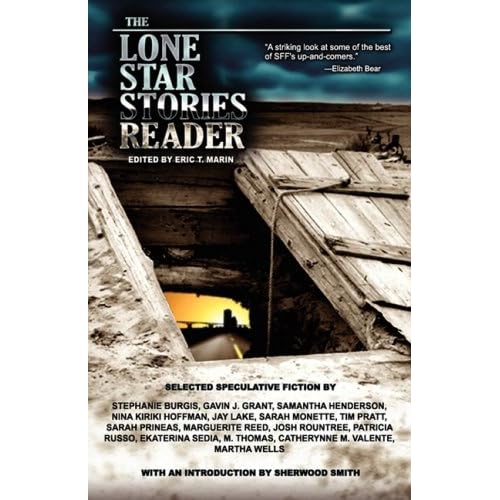
The Lone Star Stories Reader edited by Eric T. Marin
Podcast Focus: Media Sound Off
Every Friday, I'll talk about a podcast or two that catches my fancy.
URL: http://mediasoundoff.com/
RSS Feed: http://mediasoundoff.com/podcast/feed
Description: Media Sound Off digs into the new media that the Internet spawned whether it's bloggers or podcasts or online videos. If you're interested in the production side of things, what makes this new technology different from the existing one, or simply want a behind-the-scenes discussion on such matters, you might want to check out this brand-new podcast.
URL: http://mediasoundoff.com/
RSS Feed: http://mediasoundoff.com/podcast/feed
Description: Media Sound Off digs into the new media that the Internet spawned whether it's bloggers or podcasts or online videos. If you're interested in the production side of things, what makes this new technology different from the existing one, or simply want a behind-the-scenes discussion on such matters, you might want to check out this brand-new podcast.
Thursday, October 23, 2008
October 23, 2008 Links and Plugs
Go ninja go ninja go:
- Matt Staggs covers the wake of Thomas M. Disch. Photos taken by Jacob Weisman of Tachyon Publications can be found here.
- Andrew Wheeler has additional commentary on his original post, On Being Skipped: Skipping Along Merrily, Skipping the Side Issues, Borders "Boycott": Request for Information.
- It's sale season over at Norilana Books and Apex Books. I currently can't access the latter right now but do check out the books Leaving Fortusa by John Grant, The Journey to Kailash by Mike Allen, Clockwork Phoenix edited by Mike Allen, and The Duke in the Castle by Vera Nazarian.
- Here's a 2006 interview with Orson Scott Card by Mike Allen.
- Dark SF in the Modern World by Deb Taber.
- I previously linked to John Klima's blog entry on the Espresso. You can listen to Australia's ABC Radio National's take on it (MP3).
- If you're not yet a Weird Tales reader, you can download a free copy of last month's issue.


2008/10/23 Tabletop RPG Podcasts
Every Thursday, I post links to various podcasts that deals with tabletop RPGs.
Tabletop RPG (Mostly)
General Discussions/Reviews/Everything Else
- Pulp Gamer episodes: Theophrastus (The Game Kennel), Advertising: Effective Brand Communication (Gen Con 2008 Seminar), Lessons Learned - GTS Wrap-up (GAMA Trade Show 2008 Seminar).
- Animalcast episodes: Episode 63.
- Secret Identity episodes: Issue #136.
- Bear Swarm! episodes: Dealing with Drama.
- The Podge Cast episodes: Uncle Jimbone and the Case of the Disappearing Host.
- Narrative Control episodes: Episode 8.
- The Order 66 Podcast episodes: Video Killed the Radio Star Wars.
- Fear the Boot episodes: group leaders and how education impacts roleplaying.
- All Games Considered episodes: RPG Buffet HARP and Heroes.
- This Modern Death episodes: Frontloading Complexity.
- Wapcaplets episodes: Monsterpocalypse (1, 2).
- What Are You Working On? episodes: Episode 19.
- The Escapistcast episodes: Editions & Excursions.
- The Game Master Show episodes: Ending Your Game.
- Save Against Frostbite episodes: Pubic Hair and MMO Perfume.
- Role Playing Public Radio episodes: Get Your Fear On.
- Radio Free Hommlet episodes: The Fighter.
- Ninja vs. Pirates episodes: Flash Games.
- One Man and His Dice episodes: Rune Magic.
- Midnight's Lair episodes: From the Lair Issue 1 - a Midnight’s Lair Special.
- Lords of Tyr D&D Podcast episodes: Episode 11.
- Hidden Grid episodes: Update.
- Secret Identity episodes: Issue #136.5 where they interview Vincent Farrante.
- Pulp Gamer episodes: Jean Vanaise.
- The Tome Show interviews Eytan Bernstein in Saving Throws.
- Kobold Quarterly interviews Margaret Weis and Tracy Hickman.
- D&D Podcast interviews R.A. and Geno Salvatore in Episode 27.
- Geek Girls Rule episodes: Emerald City Game Fest with Sophie Legace.
- Heroic Cthulhu episodes: I Wanna Be A Cowboy (8), The Chronicles of Greenman, It's All Greek to Me (1, 2), The KBC Warriors (1, 2, 3, 4, 5, 6, 7), The Naked Man Redoux (1, 2, 3, 4, 5, 6, 7), Gamer Talk Forty Two (1, 2, 3), Bad Blood (1, 2, 3, 4, 5, 6, 7, 8, 9, 10, 11), Hotel (1, 2, 3, 4, 5, 6, 7), Construction Crunch (1, 2, 3, 4, 5, 6, 7), After the Game.
- Kore RPG episodes: We work for Keyser Söze.
- The Gamer's Haven episodes: Dungeon Crawl Classics #53 - Sellswords of Punjar (5), D&D Wizard's College (4).
- RPGMP3 episodes: Thunderspire Labyrinth (3).
- Return to Northmoor episodes: Actual Play of Session 2.
Wednesday, October 22, 2008
October 22, 2008 Links and Plugs
Mental note: writing fiction can be fun!
- Tessa gives us a Choose Your Own Adventure 101.
- CE Murphy gives us a concrete example of Showing vs. Telling.
- Juliette Wade on Don't Make Them All the Same as far as characters go.
- Dave Taylor on How to Write with a Distinctive Voice.
- Here's an interview with Elizabeth Wein. By me!
- AfterElton has a poll on 50 Greatest Gay Books. Off the top of my head, those that possibly qualify in the genre include The Left Hand of Darkness by Ursula K. le Guin, Magic's Pawn by Mercedes Lackey, and more recently, Vintage by Steve Berman.
- Here's some rapid-fire books: Pre-order The Lone Star Stories Reader at Amazon, check out The Best of Abyss & Apex Volume TOC, and give the audio extravaganza Metropolis a shot.
Essay: A Quick Run-Down on Bookstores in the Philippines Part 3
Every Wednesday, I'll have an essay or a feature on any topic that catches my fancy!
Part One, Part Two
Secondhand Bookstores
Secondhand bookstores are tricky--there's no guarantee what books they stock and no one actually gets to track what gets sold (at least as far as the publishers are concerned). Having said that, secondhand bookstores are pretty popular in the Philippines and it seems that there's always someone browsing their shelves.
Amidst the doom and gloom of the demise of reading, secondhand bookstores are showing promise and steadily expanding. If the 1990s was the boom for independent bookstores, then the current decade belongs to this cottage industry as several franchises have popped up (four new franchises in less than six years!). What I'll be covering are the franchise shops, as opposed to each individual seller than deals with secondhand books (they're too many to mention and I'm honestly not that familiar with them).
Booksale (http://www.booksale.com.ph/)
Easily one of the oldest franchises in this category, when you speak of secondhand books, the first store that comes to mind is Booksale. Quality varies from branch to branch, with some stores having a shelf for various categories, others simply lumping the books in one big pile. Many classic and hard to find science fiction/fantasy books have been found in Booksale, as well as elusive magazines like Asimov's or Ellery Queen if you're lucky. Paperbacks seems to be their specialty although they have their own sections on hardcovers and text books.
Of course bibliophiles would be wise to pay attention to the other material that Booksale actually sells. Current magazines seem to be a staple (FHM glossing their front stands beside Sudoku puzzle digests) and small forays into school supplies like ballpens. For a time, they were also selling encyclopedia-like books (there was this multi-volume series on World War II) cheaper than what they cost in the regular bookstores.
Books for Less (http://www.papemelroti.com/bfl.htm)
Branching out from its parent company, Papelmeroti (a franchise owned by five siblings, the most popular is probably Robert Alejandro from the TV show "Art is Kool"), Books for Less seems like a more sophisticated equivalent of Booksale. Whereas the latter's ambiance is best described as functional, the former looks neater and their book selection is definitely cleaner (the books aren't that yellow). Books for Less also sets itself apart by specializing in hard cover books and trades, although secondhand paperbacks can also be found in the shop. Because of the focus on hard covers, the books featured in this store tend to be more expensive than Book Sale, but still cheaper than what you'd find in conventional bookstores.

Buy-the-Book
As far as I can tell, there's nothing really remarkable about Buy-the-Book aside from the fact that it's a new franchise and has four branches (Waltermart Makati, Market! Market!, SM Manila and SM San Lazaro). You'll find books that were previously stocked in conventional bookstores here (mainly because this is a weird affiliate of the National Bookstore-Powerbooks family).
 Chapters and Pages
A new franchise appearing in shopping malls, Chapters and Pages isn't so much a "shop" as a "stall" (think of it as several bookshelves and one counter). Commonly found in open areas of the mall, Chapters and Pages seems to be popular as it attracts random passersby. My only concern is the security as it seems very easy to shoplift a book from the said store (I hope the salesladies are attentive).
 Pick A Book Supervalue Store
This franchise is masterminded by former PBA player Jun Limpot and can be found in places like SM Southmall, SM Sucat, SM Dasmarinas, and Market! Market! Pretty much follows the Booksale formula in addition to selling encyclopedias.
Part One, Part Two
Secondhand Bookstores
Secondhand bookstores are tricky--there's no guarantee what books they stock and no one actually gets to track what gets sold (at least as far as the publishers are concerned). Having said that, secondhand bookstores are pretty popular in the Philippines and it seems that there's always someone browsing their shelves.
Amidst the doom and gloom of the demise of reading, secondhand bookstores are showing promise and steadily expanding. If the 1990s was the boom for independent bookstores, then the current decade belongs to this cottage industry as several franchises have popped up (four new franchises in less than six years!). What I'll be covering are the franchise shops, as opposed to each individual seller than deals with secondhand books (they're too many to mention and I'm honestly not that familiar with them).
Booksale (http://www.booksale.com.ph/)
Easily one of the oldest franchises in this category, when you speak of secondhand books, the first store that comes to mind is Booksale. Quality varies from branch to branch, with some stores having a shelf for various categories, others simply lumping the books in one big pile. Many classic and hard to find science fiction/fantasy books have been found in Booksale, as well as elusive magazines like Asimov's or Ellery Queen if you're lucky. Paperbacks seems to be their specialty although they have their own sections on hardcovers and text books.
Of course bibliophiles would be wise to pay attention to the other material that Booksale actually sells. Current magazines seem to be a staple (FHM glossing their front stands beside Sudoku puzzle digests) and small forays into school supplies like ballpens. For a time, they were also selling encyclopedia-like books (there was this multi-volume series on World War II) cheaper than what they cost in the regular bookstores.
Books for Less (http://www.papemelroti.com/bfl.htm)
Branching out from its parent company, Papelmeroti (a franchise owned by five siblings, the most popular is probably Robert Alejandro from the TV show "Art is Kool"), Books for Less seems like a more sophisticated equivalent of Booksale. Whereas the latter's ambiance is best described as functional, the former looks neater and their book selection is definitely cleaner (the books aren't that yellow). Books for Less also sets itself apart by specializing in hard cover books and trades, although secondhand paperbacks can also be found in the shop. Because of the focus on hard covers, the books featured in this store tend to be more expensive than Book Sale, but still cheaper than what you'd find in conventional bookstores.

Buy-the-Book
As far as I can tell, there's nothing really remarkable about Buy-the-Book aside from the fact that it's a new franchise and has four branches (Waltermart Makati, Market! Market!, SM Manila and SM San Lazaro). You'll find books that were previously stocked in conventional bookstores here (mainly because this is a weird affiliate of the National Bookstore-Powerbooks family).
 Chapters and Pages
A new franchise appearing in shopping malls, Chapters and Pages isn't so much a "shop" as a "stall" (think of it as several bookshelves and one counter). Commonly found in open areas of the mall, Chapters and Pages seems to be popular as it attracts random passersby. My only concern is the security as it seems very easy to shoplift a book from the said store (I hope the salesladies are attentive).
 Pick A Book Supervalue Store
This franchise is masterminded by former PBA player Jun Limpot and can be found in places like SM Southmall, SM Sucat, SM Dasmarinas, and Market! Market! Pretty much follows the Booksale formula in addition to selling encyclopedias.
Tuesday, October 21, 2008

October 21, 2008 Links and Plugs
As usual, here's your daily dose of links:
- Writing Excuses has an interesting podcast on the subject matter of How to Write for Children. Apparently, there are three sub-categories and being 18 years old still counts as "children".
- Media Sound Off (podcast) interviews people behind the scenes of new media. The first on their list is Edward Champion, the man behind the Bat Segundo Show. It also had me thinking: aside from Rick Kleffel (for the West Coast) and Jim Freund (East Coast), who else are the smart, literary people involved in radio/podcasts?
- Brandon Sanderson on EUOlogy: My History as a Writer.
- Publishers Weekly has an interview with Kelly Link. (Pssst, Pretty Monsters, plug, plug.)
- Oh, and Harper Collins has as countdown timer for Jeffrey Ford's upcoming collection, The Drowned Life.

Interview: Mary Robinette Kowal
Every Tuesday, I'll have an interview posted.
Mary Robinette Kowal is a professional puppeteer as well as a writer. Her fiction has appeared in publications like Strange Horizons, Apex Online, and Clarkesworld Magazine. She is also the art director of Shimmer and the 2008 winner of the John W. Campbell Award for Best New Writer.
Thanks for agreeing to do the interview! Since you're both a puppeteer and a writer, how did you first fall in love with storytelling?
I remember putting on plays in my back yard when I was in elementary school. I remember writing a story for my Mom as a Mother's Day present when I was in first grade. I don't remember a time when I didn't love it.
What aspects of your storytelling cravings does puppetry satiate? How about fiction? Are there any areas where they overlap?
Actually the areas where they overlap are all over the place. In both forms, I have to do world-building, character creation, figure out how the plot relates to how the story is told. These are all like puzzle pieces that have to be fit together so that the audience can see the picture. I love that.
How did you break into the puppetry industry? Did you have to apprentice yourself or did you study it in college?
I started puppetry in high school as a hobby. When I was in college, I was performing as the plant in Little Shop of Horrors when a professional puppeteer came to see the show. Until that moment, it had never occurred to me that people would pay you to do puppets. I pretty much changed career tracks on the spot and started working with her. I went on to intern at the Center for Puppetry Arts and have been working steadily since.
How about writing? What made you decide to finally submit something to a professional market?
Part of the training I got was the importance of being paid for my art. It's not just a way to make a living, it's also a way to have an gage. If no one is willing to pay you for something that other people get paid for, there's probably something wrong. Granted, there are shows that are "for the love" types of things because there's no market for them, but largely speaking people pay for the good stuff. I know that sounds mercenary and capitalistic, but it's part of what's let me have theater as my day job for the last nineteen years.
I bring this up to explain that trying to get paid for writing seemed like a natural thing to do.
My brother had moved to China with his kids and I started writing a serial to amuse them. It turned into a novel. I started researching what one does with novels and, while shopping it around, started writing and submitting short stories.
How has your art major and theater/speech minor experience aided you in either career?
Oof. This is almost too big to answer because the truth is that it influences everything I do. The theater background gives me a sense of how story and audience interact. Art comes in handy with the puppetry because I build and design. Those are obvious ones.
But there are also subtle things like, how to critique and how to handle critiques that I learned in art school. Working with editors reminds me of working with directors. You learn to bend. And drawing... See, in drawing, you rough in the whole figure before you start doing detail work. A mistake a lot of beginners make is to start on the hand and get that perfect, and then the arm, and get that perfect. But by the time they get to the feet, they've lost the perspective and wind up with a distorted figure. I write the same way. I rough in the story in general phrases like, "Ninjas appear. Something bad happens. She solves it! Happily ever after" (Okay, quite that vague but you get the idea.) Then once I've got that, I start filling in the details. Sometimes, I'll move a limb, so to speak, to bring the composition into better balance, but it's still very much like the drawing process to me.
What are some of your favorite puppets?
Bill Baird's Scheherazade. Kermit, of course. The Bound Man at the Center for Puppetry Arts (Yes, my short story is titled after him, but bears no resemblance to the show he is from). And then of my own... Gerta from the Snow Queen, if I had to pick just one. Or maybe Shiro from "The Old Man Who Made Trees Blossom" but I think I like the character more than the puppet. It's hard to separate them.
How about favorite authors/books?
Guy Gavirel Kay's "Song for Arbonne"
Myrtle Reed "Flower of the Dusk"
Robert A. Heinlein "Stranger in a Strange Land"
Elizabeth Moon "Speed of Dark"
You know what this would be a long list. Let's use modern technology. Here's my LibraryThing account sorted for favorites.
What lesson sticks out the most for you from Orson Scott Card's Literary BootCamp?
Scott was talking about the difference between short stories and novels and said something like, "Imagine you are going to an island on a lake, In a short story, you get in the boat and head across to the island. In a novel, you can stop and have a picnic, meander around the shore or go fishing on your way there. In both cases, you are still going to the island."
What made you decide to apply for Launchpad? Similarly, what's a lesson you learned there that still resonates with you?
I had a number of friends who were accepted to the first year and they all raved about it. Plus, big telescopes. Hello? Why not apply.
A lot of Launchpad is still settling in. I think Jerry Oltion's tour of the universe was the most immediately useful because it got me thinking about the settings for extra-solar worlds and the sheer scale of the universe. We did this exercise where we tried to scale the solar system to fit inside our 30' classroom. In order to get it to fit, the sun could be no larger than a mustard seed. Jupiter was a grain of salt and Pluto would have been at the very edge of the classroom. Alpha Centauri, our closest neighbor, would have been another mustard seed (two actually, it's a binary) thirty miles away. Now imagine getting in a spaceship and flying there.
Congrats on recently winning the Campbell Award. How does it feel to win the award?
Thank you! It feels wonderful and surreal at the same time. I was describing this to my husband as the way I felt the first time I wrote my married name. It was wonderful, but I still looked at "Kowal" and thought "that's not me." It took a while for it to settle in because there was a disparity between my internal landscape and the external landscape. The Campbell Award is much like that. Totally exhilarating but every time I see "award-winning author" attached to my name I feel like they must be talking about someone else.
Among your fellow nominees, who are some of the writers that you admire? How about previous Campbell winners/nominees?
All of them. I read all of the other nominees' books, because I wanted to know what they wrote. The books are wildly different and all quite wonderful. I've had the pleasure of meeting or emailing with almost all of them and they are all very nice people too. I would have been happy to see any of them win.
Previous nominees? Jay Lake, John Scalzi, Elizabeth Bear, Orson Scott Card... being on the same list with them staggers me.
What was the most challenging experience working on Shimmer Magazine? Most rewarding?
The second issue. We had some trouble with the printer that we thought we got straightened out, but the second issue was... problematic and we had to frantically find another printer at the last minute. Right now, the biggest challenge is finding time to work on it. My life has been much busier in NYC than in Iceland or Oregon. Most rewarding? Every time the magazine arrives from the printer. Every time I get to meet one of our authors. I'm very proud of the magazine and love doing it. I just wish I had more time.
What made you decide to run for SFWA Secretary? Any challenges you're currently running into?
A volunteer run organization is only as good as its volunteers. I'd seen SFWA do a lot of good things, but it was clear that they were pulling on the same bank of people all the time. I have a lot of experience with non-profit arts organizations and know how powerful they can be for their members. I wanted to be part of that.
Challenges? Actually, the new board is pretty collegial. Considering that we've been drafting new bylaws and adjusting other policies to bring SFWA into the twenty-first century, it's been pretty painless.
How did you first get involved with podcasts? How does your husband help you with your own podcasts?
I started in radio theater, with Willamette Radio Workshop but it wasn't until talking to Orson Scott Card at his bootcamp that it occurred to me to actually record audio fiction. My first recording was his "The Middle Woman" for Intergalactic Medicine Show's inaugural issue.
And yes, Rob definitely helps me. We're using his audio gear and he engineers them.
What for you constitutes a good podcast?
I have a hard time listening to them if they are compressed too much or if there are other recording issues. So if it's clean audio and a good story I'll be happy. I enjoy EscapePod, If You are Just Joining Us and This American Life.
I'm curious at how you end up reading other people's stories. Like how did Subterranean Press know you provided such services?
Word of mouth. I'd met John Scalzi at Readercon. We started talking about stuff and at some point the radio theater background came up. When he recorded, The Sagan Diary, with various women SF writers, he asked me to read for it.. Bill Schaffer heard me there and asked me to record Kage Bakers "Rude Mechanicals." Everything else sort of rolls from there.
If I were a good girl, I'd have my demo reel up online, but you know that saying about cobbler's children never having shoes? Yeah, just adjust it to refer to audio engineer's wives.
Have you thought of podcasting more of your own fiction?
Yes, but while we are in NYC the recording situation is so unpleasant that it is not going to happen.
How did you find/select your writing agent?
I got very lucky. Ken Scholes recommended me to his agent, Jennifer Jackson, at Donald Maass, I had heard very good things about her. So I sent in my manuscript and she accepted me.
Any advice for aspiring puppeteers?
Find a good company and apprentice there for a year. Then never work for free again.
Advice for aspiring writers?
Write, submit, repeat. Don't feel like you have to sell things in the order in which you write them. Look at the big picture.
Advice for aspiring podcasters?
Turn off the refrigerator, air conditioner and any florescent lights before recording.If you can hear it, so can we.
Anything else you'd like to plug?
I've got a story (Waiting for Rain) in this month's Subterranean online that I wouldn't mind sending some traffic towards.
http://subterraneanpress.com/index.php/magazine/fall-2008
Mary Robinette Kowal is a professional puppeteer as well as a writer. Her fiction has appeared in publications like Strange Horizons, Apex Online, and Clarkesworld Magazine. She is also the art director of Shimmer and the 2008 winner of the John W. Campbell Award for Best New Writer.
Thanks for agreeing to do the interview! Since you're both a puppeteer and a writer, how did you first fall in love with storytelling?
I remember putting on plays in my back yard when I was in elementary school. I remember writing a story for my Mom as a Mother's Day present when I was in first grade. I don't remember a time when I didn't love it.
What aspects of your storytelling cravings does puppetry satiate? How about fiction? Are there any areas where they overlap?
Actually the areas where they overlap are all over the place. In both forms, I have to do world-building, character creation, figure out how the plot relates to how the story is told. These are all like puzzle pieces that have to be fit together so that the audience can see the picture. I love that.
How did you break into the puppetry industry? Did you have to apprentice yourself or did you study it in college?
I started puppetry in high school as a hobby. When I was in college, I was performing as the plant in Little Shop of Horrors when a professional puppeteer came to see the show. Until that moment, it had never occurred to me that people would pay you to do puppets. I pretty much changed career tracks on the spot and started working with her. I went on to intern at the Center for Puppetry Arts and have been working steadily since.
How about writing? What made you decide to finally submit something to a professional market?
Part of the training I got was the importance of being paid for my art. It's not just a way to make a living, it's also a way to have an gage. If no one is willing to pay you for something that other people get paid for, there's probably something wrong. Granted, there are shows that are "for the love" types of things because there's no market for them, but largely speaking people pay for the good stuff. I know that sounds mercenary and capitalistic, but it's part of what's let me have theater as my day job for the last nineteen years.
I bring this up to explain that trying to get paid for writing seemed like a natural thing to do.
My brother had moved to China with his kids and I started writing a serial to amuse them. It turned into a novel. I started researching what one does with novels and, while shopping it around, started writing and submitting short stories.
How has your art major and theater/speech minor experience aided you in either career?
Oof. This is almost too big to answer because the truth is that it influences everything I do. The theater background gives me a sense of how story and audience interact. Art comes in handy with the puppetry because I build and design. Those are obvious ones.
But there are also subtle things like, how to critique and how to handle critiques that I learned in art school. Working with editors reminds me of working with directors. You learn to bend. And drawing... See, in drawing, you rough in the whole figure before you start doing detail work. A mistake a lot of beginners make is to start on the hand and get that perfect, and then the arm, and get that perfect. But by the time they get to the feet, they've lost the perspective and wind up with a distorted figure. I write the same way. I rough in the story in general phrases like, "Ninjas appear. Something bad happens. She solves it! Happily ever after" (Okay, quite that vague but you get the idea.) Then once I've got that, I start filling in the details. Sometimes, I'll move a limb, so to speak, to bring the composition into better balance, but it's still very much like the drawing process to me.
What are some of your favorite puppets?
Bill Baird's Scheherazade. Kermit, of course. The Bound Man at the Center for Puppetry Arts (Yes, my short story is titled after him, but bears no resemblance to the show he is from). And then of my own... Gerta from the Snow Queen, if I had to pick just one. Or maybe Shiro from "The Old Man Who Made Trees Blossom" but I think I like the character more than the puppet. It's hard to separate them.
How about favorite authors/books?
Guy Gavirel Kay's "Song for Arbonne"
Myrtle Reed "Flower of the Dusk"
Robert A. Heinlein "Stranger in a Strange Land"
Elizabeth Moon "Speed of Dark"
You know what this would be a long list. Let's use modern technology. Here's my LibraryThing account sorted for favorites.
What lesson sticks out the most for you from Orson Scott Card's Literary BootCamp?
Scott was talking about the difference between short stories and novels and said something like, "Imagine you are going to an island on a lake, In a short story, you get in the boat and head across to the island. In a novel, you can stop and have a picnic, meander around the shore or go fishing on your way there. In both cases, you are still going to the island."
What made you decide to apply for Launchpad? Similarly, what's a lesson you learned there that still resonates with you?
I had a number of friends who were accepted to the first year and they all raved about it. Plus, big telescopes. Hello? Why not apply.
A lot of Launchpad is still settling in. I think Jerry Oltion's tour of the universe was the most immediately useful because it got me thinking about the settings for extra-solar worlds and the sheer scale of the universe. We did this exercise where we tried to scale the solar system to fit inside our 30' classroom. In order to get it to fit, the sun could be no larger than a mustard seed. Jupiter was a grain of salt and Pluto would have been at the very edge of the classroom. Alpha Centauri, our closest neighbor, would have been another mustard seed (two actually, it's a binary) thirty miles away. Now imagine getting in a spaceship and flying there.
Congrats on recently winning the Campbell Award. How does it feel to win the award?
Thank you! It feels wonderful and surreal at the same time. I was describing this to my husband as the way I felt the first time I wrote my married name. It was wonderful, but I still looked at "Kowal" and thought "that's not me." It took a while for it to settle in because there was a disparity between my internal landscape and the external landscape. The Campbell Award is much like that. Totally exhilarating but every time I see "award-winning author" attached to my name I feel like they must be talking about someone else.
Among your fellow nominees, who are some of the writers that you admire? How about previous Campbell winners/nominees?
All of them. I read all of the other nominees' books, because I wanted to know what they wrote. The books are wildly different and all quite wonderful. I've had the pleasure of meeting or emailing with almost all of them and they are all very nice people too. I would have been happy to see any of them win.
Previous nominees? Jay Lake, John Scalzi, Elizabeth Bear, Orson Scott Card... being on the same list with them staggers me.
What was the most challenging experience working on Shimmer Magazine? Most rewarding?
The second issue. We had some trouble with the printer that we thought we got straightened out, but the second issue was... problematic and we had to frantically find another printer at the last minute. Right now, the biggest challenge is finding time to work on it. My life has been much busier in NYC than in Iceland or Oregon. Most rewarding? Every time the magazine arrives from the printer. Every time I get to meet one of our authors. I'm very proud of the magazine and love doing it. I just wish I had more time.
What made you decide to run for SFWA Secretary? Any challenges you're currently running into?
A volunteer run organization is only as good as its volunteers. I'd seen SFWA do a lot of good things, but it was clear that they were pulling on the same bank of people all the time. I have a lot of experience with non-profit arts organizations and know how powerful they can be for their members. I wanted to be part of that.
Challenges? Actually, the new board is pretty collegial. Considering that we've been drafting new bylaws and adjusting other policies to bring SFWA into the twenty-first century, it's been pretty painless.
How did you first get involved with podcasts? How does your husband help you with your own podcasts?
I started in radio theater, with Willamette Radio Workshop but it wasn't until talking to Orson Scott Card at his bootcamp that it occurred to me to actually record audio fiction. My first recording was his "The Middle Woman" for Intergalactic Medicine Show's inaugural issue.
And yes, Rob definitely helps me. We're using his audio gear and he engineers them.
What for you constitutes a good podcast?
I have a hard time listening to them if they are compressed too much or if there are other recording issues. So if it's clean audio and a good story I'll be happy. I enjoy EscapePod, If You are Just Joining Us and This American Life.
I'm curious at how you end up reading other people's stories. Like how did Subterranean Press know you provided such services?
Word of mouth. I'd met John Scalzi at Readercon. We started talking about stuff and at some point the radio theater background came up. When he recorded, The Sagan Diary, with various women SF writers, he asked me to read for it.. Bill Schaffer heard me there and asked me to record Kage Bakers "Rude Mechanicals." Everything else sort of rolls from there.
If I were a good girl, I'd have my demo reel up online, but you know that saying about cobbler's children never having shoes? Yeah, just adjust it to refer to audio engineer's wives.
Have you thought of podcasting more of your own fiction?
Yes, but while we are in NYC the recording situation is so unpleasant that it is not going to happen.
How did you find/select your writing agent?
I got very lucky. Ken Scholes recommended me to his agent, Jennifer Jackson, at Donald Maass, I had heard very good things about her. So I sent in my manuscript and she accepted me.
Any advice for aspiring puppeteers?
Find a good company and apprentice there for a year. Then never work for free again.
Advice for aspiring writers?
Write, submit, repeat. Don't feel like you have to sell things in the order in which you write them. Look at the big picture.
Advice for aspiring podcasters?
Turn off the refrigerator, air conditioner and any florescent lights before recording.If you can hear it, so can we.
Anything else you'd like to plug?
I've got a story (Waiting for Rain) in this month's Subterranean online that I wouldn't mind sending some traffic towards.
http://subterraneanpress.com/
Subscribe to:
Posts (Atom)