Monday, May 25, 2009

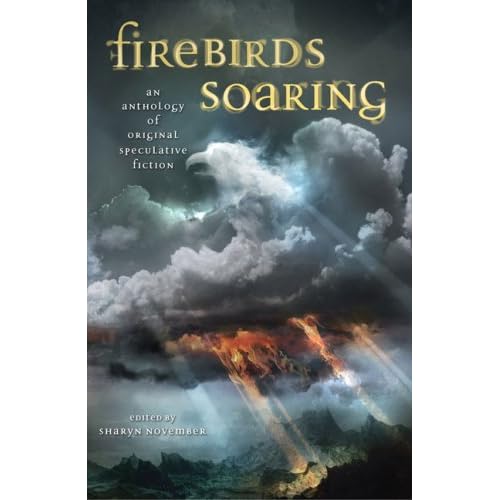
Book/Magazine Review: Firebirds Soaring edited by Sharyn November

Every Monday, I'll be doing spoiler-free, bite-sized book/magazine reviews.

At the Penguin site, Firebirds is described as an imprint designed to appeal to both teenagers and adults. That's a fair summation of this anthology which features nineteen fantastical stories, all of which have a young adult tone. Sharyn November assembles a gamut of authors and stories tackling various ideas, from adventures in the real world to high fantasy settings to anthropomorphic protagonists.

My assessment of this anthology is that it's a mixed bag, although for the most part it was a pleasant experience. Initially, there were some stories that felt too didactic, and a rare few where the prose was clunky. Firebirds Soaring also has its share of excellent stories that stand out, which I'll talk about more later on. Majority fell somewhere in the middle, above average as far as I'm concerned, although perhaps not as memorable as I would have wanted. Still, at nineteen stories, there's a lot to devour, and each story is accompanied by an explanation from the author on how their story developed.

"A Thousand Tails" by Christopher Barzak is an excellent story. The language is compelling, even as Barzak tackles a very discomforting social issue. While his setting is alien to most readers--save for the cliches we see in anime or read in manga--Barzak includes just enough detail that makes it feel right. There's also the incorporation of the fantasy element, not overt but a subtle piece that keeps readers wondering whether it's true or not. All of this however is for naught if the reader doesn't sympathize with the protagonist and the author successfully juggles the right amount of vulnerability and empowerment.

"The Ghost of Strangers" by Nina Kiriki Hoffman is one of the lengthier pieces in the anthology but it earns its keep. In a certain way, this is a miniature epic in itself as we witness the maturation of the protagonist from youth to a certain level of adulthood. What's dominant here is the sense of exploration, whether it's discovering our heroine's capabilities, the mystery of dragons, the crisis that pops up in the story, or the characters and the world she eventually encounters. While Hoffman's writing is not perfect--the pace could have been faster--she does manage to pack a lot of complex elements into this tale and re-invent how we perceive dragons.

"Court Ship" by Sherwood Smith is this adventurous fantasy romp featuring princes, pirates, drama, and action. It's an upbeat story that keeps you wanting more and Smith creates a cast of characters that are fleshed out and complex. Perhaps in terms of depth, there are other stories in the anthology that fit that bill but if you want a story that's fun without falling into the trap of a two-dimensional fantasy, "Court Ship" is one of the better secondary world fantasies that I've read.

Overall, while there are some low points in Firebirds Soaring, majority are competent reads that's accessible to a wide audience. Mike Dringenberg has excellent art that captures the atmosphere of each story and there's an elegance in the book's design.

Friday, May 22, 2009

May 22, 2009 Links and Plugs

Book Bigayan 2009 this Sunday in protest of the Book Blockade.

And tomorrow is Free Comic Book day at Fully Booked.

And September 16, 2009 is the Manila International Book Fair.

Interviews
Advice/Articles
News
And here's a nonfiction title that might interest you:

The Jewel-Hinged Jaw Notes on the Language of Science Fiction by Samuel R. Delany

And as a bonus for Matt Staggs:

Chaos by Escober

Quick Note on "Boycotting Taxed Books"

You know what's one of the stupidest solutions I've heard regarding opposing the book blockade? Boycotting the duty books. Because:
  • How do you determine which books are being taxed?
  • The taxes are already paid.
  • Books are good, taxes bad. You don't avoid the former just because of the latter.
  • It'll drive local business owners out of business.
  • While stores might not outlast a boycott, the government (or rather the Department of Finance) will.
  • Print illiteracy wins.
What needs to be done:
  • Put pressure on the Department of Finance (Customs might be deplorable but if it's just the taxing issue, they're not the ones we should be going after) to reverse the tax. And by the Department of Finance, I mean Undersecratary Sales or her boss, Secretary Teves (and irony of ironies, I went to a National Bookstore branch where there's a sign praising Secretary Teves--what does that say about Teves? NBS? Hopefully it's a paid sign).
  • Spread awareness of the issue. And by awareness, I mean legitimate concerns rather than the fallacies and misconceptions surrounding the issue.
  • Encourage the media and politicians to talk about the issue.

Top 10 Best-Sellers as of 2009/5/17

From USA Today's best-seller list (you can find out their basis here):
  1. New Moon by Stephenie Meyer
  2. Percy Jackson and the Olympians: The Last Olympian by Rick Riordan
  3. Twilight by Stephenie Meyer
  4. Eclipse by Stephenie Meyer
  5. Angels & Demons by Dan Brown
  6. Breaking Dawn by Stephenie Meyer
  7. Vision in White by Nora Roberts
  8. The Shack by William P. Young
  9. Wicked Prey by John Sandford
  10. The Guernsey Literary and Potato Peel Pie Society by Mary Ann Shaffer and Annie Barrows

Thursday, May 21, 2009

May 21, 2009 Links and Plugs

When it comes to positive news, books that arrived in the mail include The Best of Michael Moorcock (edited by John Davey with Jeff & Ann VanderMeer), Spotted Lily (by Anna Tambour), and Monterra's Deliciosa & Other Tales & (also by Anna Tambour).

Also check out my interview with Ian McDonald which seems apt for this week's Fen of Color.

Interviews
Advice/Articles
News
Check out this magazine that just got released:

Wednesday, May 20, 2009

Fictional Ad II

If D&D had Gray Caps...

"These intelligent, mobile mushroms are among the more unusual creatures that live deep below ground. Myconids (also called fungus ones) are gentle, quiet, shy, and thoughtful." - Monster Manual II

May 20, 2009 Links and Plugs

Brain explodo.

And my crush doesn't want me to send her books, *sniff* *sniff*

Interviews
Advice/Articles
News
May 18th, 2009
Check out this book:

Fictional Ad

Gray Cap (illustration by Eric Schaller)

Not a Gray Cap

Feature: "Who Is Jeff VanderMeer?"

Every Wednesday, I have an essay or feature article on any topic that catches my fancy!

Roughly three ago, I didn't know who Jeff VanderMeer was (and for that matter, I didn't know who Jeffrey Ford was a few years back--what is it with the J's?). The first I had heard of him was through the venerable Dean Francis Alfar who commanded me to find him a copy of The Thackery T. Lambshead Pocket Guide to Eccentric & Discredited Diseases as I was the resident book pimp. Unfortunately, I failed but got the chance to redeem myself when Alfar was interested in acquiring City of Saints and Madmen. Little did I know that the latter has an interesting history (and multiple versions that compound on the previous releases--you can read the history here and here ) but as fate would have it, I found a black hardcover at Fully Booked, selling for half price and ignored by most people. It was sitting on a shelf too high for me to reach that I had to contact customer service and they promptly got a small ladder to reach the book (advice to bookstores: don't place books out of reach). I inspected it just to make sure it was the real thing and in retrospect, it was the Pan MacMillan/Tor UK hardcover edition. There were three copies lying around, each one selling for P700 (roughly $14.00 at today's exchange rate) and while I was tempted to purchase more than one copy, I was strapped for cash. I quickly browsed through the book that would soon belong to Alfar, admired the artwork, and stored it in my bag. Later that day, I arrived at the home of artist Rom Villaserran who complimented the book's cover. I would have given him a copy of the book then and there but unfortunately, I didn't own the book.
One year later, I would curse myself for not snagging those spare copies of City of Saints and Madmen. A mass-market version was available at local stores but the newer version was missing most of the art save for the occasional mushroom (to be fair, it retains the art from the appendix). By then, I had read Veniss Underground which I found to be an interesting novel which I couldn't help but compare to China Mieville's New Crobuzon. In this instance though, I found VanderMeer's writing to be superior and more upbeat. At this point, the name Jeff VanderMeer was this vague creature. He was a writer of the New Weird (I didn't call it the New Weird back then)? He was this avante-garde author? Later on, it would be book scavenger Joseph Nacino who would utter the name Jeff VanderMeer like a mantra. This was probably life's way of telling me "you should pay attention to Jeff VanderMeer!"

Which was important because a quick Google search revealed that he had a blog! And wrote for Omnivoracious, Amazon's blog. And a bazillion other publications. I realized that I was merely scratching the surface. Back then, VanderMeer was plugging his various anthologies, from Steampunk to Fast Ships, Black Sails. Okay, so VanderMeer isn't just a writer (and not just a New Weird writer at that), he's an editor too (which is a realization that came late considering I first heard of him through The Thackery T. Lambshead Pocket Guide to Eccentric & Discredited Diseases). Looking back at his bibliography, I observed that he had written a few novels, including the aforementioned City of Saints and Madmen and Shriek: Afterword--both of which were set in his Ambergris setting. Now City of Saints and Madmen was a book unlike anything I've ever encountered before, hence my preconception that VanderMeer was this cutting-edge, avante-garde writer. Just when I thought I had him figured out, VanderMeer announces that he's writing Predator: South China Seas novel. This is, of course, a complete shock to my existing paradigm and I wasn't alone.

"Predator? As in the same predator with Arnold Schwarzanegger?" asked a friend.

I nodded and this necessitated a new mental model of Jeff VanderMeer. If I was a decade younger (or naive), I'd probably think that VanderMeer was a sell-out (not that there's anything wrong with writing media tie-in novels). So I dug deeper into his history.

It's tempting to latch on to the idea that VanderMeer was always successful (in the sense that he's productive and famous) but that's the result of long, hard work. In many ways, VanderMeer follows a punk aesthetic, especially when you consider the fact that he's been active in the speculative fiction industry for more than two decades. He founded the Ministry of Whimsy and while it might contain the stigma of vanity press, at least when it comes to the Leviathan series (in which VanderMeer is co-editor for volumes 1-3), it's not like the anthologies weren't lauded. And over the years, VanderMeer has produced material that defies convention, from The Thackery T. Lambshead Pocket Guide to Eccentric & Discredited Diseases, City of Saints and Madmen, to the various incarnations of Shriek: An Afterword (movie, soundtrack, stamps). In that context, Predator: South China Seas is a perfect fit in the sense that it's something that VanderMeer hasn't tried before, and doesn't shirk from attempting. I'm not even including work that bridges the fiction/non-fiction divide such as Secret Life (not to be confused with Secret Lives), Why Should I Cut Your Throat?, or the upcoming The Kosher Guide to Imaginary Animals.

What truly excites me about VanderMeer is that to simply call him a writer or editor is to ignore his other facets: reviewer, columnist, publisher, promoter, columnist, scholar, teacher, blogger, etc. And he manages to successfully juggle all of those as if he was a mutant hybrid of a chimera and a hydra. Some people are content being successful in one field but that's not the case with VanderMeer. He continues to innovate which brings me to the reason why I'm writing this.

Product Placement! Pre-order the book here.

VanderMeer's third Ambergris novel, Finch, is coming out later this from Underland Press. Now as varied as VanderMeer's short stories and novels are from one another, a recurring subject he often goes back to every few years is Ambergris. What is Ambergris? It's this secondary world where humans live among mushroom people (called Gray Caps). My own words do the setting no justice and while it's easy to imagine Super Mario Bros. when I mention mushroom people (Toad anyone?), VanderMeer actually makes them threatening, eerie, and alien. Let me tackle the three books briefly:

City of Saints and Madmen for me redefines the mosaic novel. My preconception of a mosaic novel is something along the lines of Thieves World where a bunch of authors collaborate on the same setting, using the same cast of characters and creating a unified narrative despite writing independent short stories. This book, however, isn't like that. If fantasy fans admire J.R.R. Tolkien on his historical approach to fantasy, as was the case with Silmarillion, VanderMeer takes that premise to the next level. City of Saints and Madmen isn't about any specific character but Ambergris as a whole. You'll find fictional histories (complete with footnotes), bibliographies, appendices, and various short stories. In fact, it's too faithful to the nonfiction material it's mimicking that the writing can get dry and boring (can you really imagine yourself reading several pages of fabricated bibliographies?). But taken as a whole, VanderMeer succeeds in experimenting with structure and form.

Shriek: An Afterword, on the other hand, is a more conventional narrative in the form of a biography (not autobiography!) that's annotated by the very subject it's talking about. It builds upon what's established in the previous novel but stands well on its own. If City of Saints and Madmen experiments with form and structure, Shriek: An Afterword experiments with technique. This is an incredibly layered read, the type that one can easily gloss over but rewards those that pay attention (as opposed to needing to pay attention the entire way, which is the case with James Joyce's Ulysses).

Finch may be the third book in the series but it's completely unlike the first two books. While admittedly its experimentation is less overt (overt being the key word here and I wouldn't be surprised if I missed a meta-textual commentary by VanderMeer), it nonetheless veers towards an unexpected direction with its mystery atmosphere. There's a lot of fantastical elements and genre tropes but all throughout, the book is written with a certain seriousness and drama. Throw in various other elements such as Steampunk and Magic-Realism and you end up with a book that's sophisticated and has a steady build-up. Perhaps the biggest treat for Ambergris fans is that VanderMeer finally answers some enigmas in the previous books, while still being accessible to new readers.

An interesting metafictional layer (as if VanderMeer wasn't metafictional enough) when it comes to all three books is its publishing history: three different publishers (well, at least when it comes to the initial publisher of City of Saints and Madmen) and three entirely different novels yet all written by the same author and set in the same cosmology. Looking at the titles released by Underland Press, Finch is (intentionally?) a perfect match for them, especially with the vibe it conjures.

Over the past few months, I've gotten to known Jeff VanderMeer a bit more but I'm honestly no closer to answering "Who is Jeff VanderMeer?" The only thing I'm certain of is that he'll surprise me as he never ceases to experiment and innovate (assuming the Gray Caps or the squids or the finger puppets don't get to him first).

Feature: Brief Points on A Post-Book Blockade Philippines

Every Wednesday, I have an essay or feature article on any topic that catches my fancy!

To Tax or Not To Tax?

Personally, I'm not against taxing books per se. However, Undersecretary Sales' implementation leaves much to be desired such as:

1) Failing to comply to international law, in this case the Florence Treaty. Tax books, fine, but our government shouldn't claim that it's honoring--at the very least--the spirit of the Florence Treaty. Opt out of the treaty, at least there's no hypocrisy that way.

2) Due process of passing "new" laws. There's a complex system for proposing new laws and Undersecretary Sales is free to propose the taxation of books. Let's at least honor our own legal system. Otherwise, why have our existing government set-up in the first place if due process is just going to be arbitrarily bypassed, whether it's Undersecretary Sales or someone else?

3) Lack of coordination between the various departments. Department of Education might want to promote reading but Department of Finance creates a policy that undermines that goal.

Books are not Educational.

For me, the problem is determining which books are educational, scientific, or cultural. It's as precarious as determining genres. Books are art and unfortunately, there's no empirical way (i.e. something that can be consistently proven) to judge them. For example, we have George Orwell's Animal Farm. It's a fantasy novel (and there are those who would argue that it's a "novel" period and shouldn't have the fantasy label attached to it). When the book initially got released, does it qualify as educational? For the sake of argument, let's say no. And then later on, due to the various reactions, it became this literary icon for anti-communism and several schools included it as part of its curriculum. It may not have been classified as educational originally but for certain schools and universities, it did become educational. So there's no real fixed standard to these things and honestly, a university's syllabus will be in constant flux. There's no empirical way to determine whether a book is "educational," unless Undersecretary Sales really means "text books," in which case I think the original law would simply have mentioned text books.

And if what's "educational" is already in a precarious situation of being defined, how much more a looser term such as "cultural?"

What's even scarier is who gets to unanimously claim which books fall under which category (or rather exclude them from, say, being cultural). It may not be direct censorship, but it's a policy that discourages specific titles (which is fine if we're not claiming to be a "free" and democratic country).

It's fine to tax -insert type of book here- but we should make exemptions on -insert type of book here-

The problem here is who gets to determine which books should be exempt and which shouldn't? Or why should Book X be taxed but Book Y not? Those looking for such a policy is only interesting in furthering their own agenda rather than everyone's. (For example, I'm sure the Church would love to tax books like Da Vinci Code and make exemptions on books like The Bible. But why should we give preference to the Church as opposed to everyone else?)

Also, see the previous point.

And not to rant, but other mediums such as comics have been proven to be educational/cultural, such as Art Spiegelman's Maus. Or magazines such as Playboy have featured literary fiction from authors like John Steinbeck, Ernest Hemmingway, and Jack Keruoac, despite what others might think of the rest of its content.

The new law is good for local book publishing.

Wrong again.

First off, some local publishers have their books printed (publishing isn't simply about printing the books) outside of the country. They will be taxed.

Second, some companies are in the business of importing/distributing foreign books for local consumption. Local business, foreign materials. They will be taxed.

Third, if you think Filipinos will buy more local books because a) import books are more expensive or because b) there's suddenly less import books on the shelves (honesty an unlikely possibility), then you're working on a wrong assumption. (Granted, this isn't a fact and can be argued against, but when was the last time you bought a local book because you couldn't purchase an import?)

Fourth, if you think this will encourage local publishers to acquire the rights to reprint foreign titles and print them locally, that's also an unlikely scenario. Local publishers don't do that in the first place because there's usually an expensive licensing fee to do so--thus making the local reprint expensive as well even if the publisher could afford it. There are some exemptions of course (i.e. Ang Munting Prinsipe) but they're the exception rather than the norm. Acquiring local reprint rights for a mid-list author might cost $500~$1,000, which in the case of the Philippines translates to a publisher's entire marketing budget for the year, or the actual cost for the book's initial print run.

Fifth, a lot of the people involved in local publishing read foreign books too. Unless you want to encourage a stagnation in creativity where the only books people read are those written by fellow Filipinos.

Local books are being sold at a high profit margin because they retail for less than their US counterparts.

First off, honestly, the only way to determine the profit margin of any business is to get a look at their accounting books. I'm not privy to those details.

If certain bookstores (i.e. National Bookstore) sell books at a cheaper rate than in the US, it's because they have a system in place that subsidizes the expenses. Such as selling school supplies (and National Bookstore honestly doesn't have to sell books or price them as cheaply--a good chunk of their income is derived from selling school supplies; in The 2000 Philippines Yearbook, Clinton Palanca interviews Socorro Ramos and is quoted for saying "If I didn't sell the pencils, I wouldn't be able to sell the books."). (And if you notice, this is the common trend for the past few decades, such as the case with Goodwill Bookstore.) That's also why in independent bookstores, books are being sold at higher than the US retail price.

Bookstores might be given distributor discount (30%? 60%?) but they have 1) overhead costs, 2) shipping costs, 3) pay its staff, 4) make profits, and 5) pay its taxes (different for custom duties). Anyone who has experience in business will know that a few percent can mean the difference between staying in business or not.

No new books were being imported during the book blockade.

Old news but I want to reiterate this fact: the statement above is false. "...customs curtailed all air shipments of books entering the country." That's air shipments. Books were still being delivered through sea (which is how most bookstores transport their stocks). The new law, however, taxes all shipments, whether via air or by sea.

Having said that, here are some points I want to make:

Undersecratary Sales should not be surprised at the reactions.

According to various sources, people did express their distress when Undersecretary Sales proposed the customs tax. Why she didn't listen to them, I don't know. Did she understimate the public's reaction? Or is simply the type of person who ignores feedback?

The law hurts the lower-income people.

Guys and gals, let's face it. The rich will shop abroad or consider the increase in costs negligible. The slightly-less wealthy buy their books online. Majority of people who buy their books in local brick and mortar stores will be the middle-class and those with lower incomes.

Whether there actually be an increase in book prices.

Honestly, the correct answer here is I don't know. I can only say that the independent bookstores are more likely to increase their prices compared to the mainstream bookstores but that's no guarantee whether they actually will or not. There are a lot of variables in business, such as gas. This new tax is simply another of those variables. Whether it's enough to justify a price increase depends on their business plan and how it relates to the other variables (i.e. when the peso-dollar ratio or gas prices were increasing, not everyone raised the prices of their products). And when bookstores do increase their prices, it won't necessarily just be by 1% or 5%.

It doesn't affect certain businesses that sells books.

Comic shops sell books. In a mailing list, I got into this argument regarding gaming books being sold in hobby shops. They're not affected by this tax mainly because they never declared their inventory as imports falling under the Florence agreement. I talked to a friend who owns a comic shop and they're paying regular import duties for the comics they bring in, which is based on a formula that takes into account the weight of the shipment and its invoice price.

Not enough media exposure.

The fight that book aficionados should fighting right now is that of propaganda. Aside from money, a good motivator for politicians to act is through social pressure and that's usually through the media. (I expected more posturing from politicians, especially with elections coming up soon, and this could be a platform people that their supporters could rally on.)

Unfortunately, right now, despite attempts by personalities like Manuel Quezon III, there's really not a lot of coverage regarding the issue. It's not making the headlines, whether in TV or print (although thankfully there are editorials and columns tackling the issue). I really love the grass-roots campaign that's going on here in the Internet, but I honestly don't think it should end there.

Why not a lot of people are aware of the issue.

Because not everyone who needed to be informed about this new law was actually informed. Sure, Sales may have contacted the booksellers, but they're not the only ones affected by this. There's the local publishers for example. They might have published in the Inquirer the new law but how can the lay man (myself included) understand all that legal jargon? There's also a lot of misconception and ignorance about what the new lay entails. If, for example, I said that tuition will go up by 1~5%, would more citizens be up in arms? (Clearly this won't cause tuition to go up by that much but let's say you're an English Major who needs to read ten [Western] literary books in a semester. Those books will be taxed. Unless the government is encouraging our lack of respect for intellectual property laws via rampant photocopying, even if it is for educational purposes.)

Taking it to court is a long and tedious process.

It's a last resort but right now, I'd bet more on increasing media exposure rather than relying on court of law to reverse the decision.

This policy is embarrassing.

It's honestly embarrassing to the other countries who actually honor the Florence Treaty. And if we're willing to break this treaty, what else are we willing to break? (It doesn't help that piracy and corruption runs rampant in this country.)
Tuesday, May 19, 2009

May 19, 2009 Links and Plugs

Because Gang will kill me if I don't mention it, Rock Ed will be having Book Giveaway Activity at the Baywalk, from 3-6 pm on May 24. Bring books and trade it with other people. The rest will be given away.

Today (technically yesterday in my part of the world) is when people are posting their Fen of Color blog entries.

Interviews
Advice/Articles
News
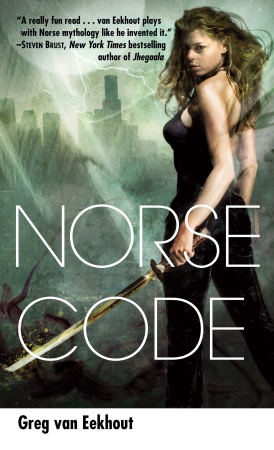
And today's the book release of Greg van Eekhout's novel. Go visit your bookstore and buy!


Norse Code by Greg van Eekhout

Interview: Catherynne M. Valente

Every Tuesday, I'll have an interview posted.


Catherynne M. Valente's poetry and short fiction can be found online and in print in such journals as The Pedestal Magazine, Fantastic Metropolis, The Journal of Mythic Arts, Clarkesworld Magazine, Jabberwocky, Mythic Delirium, Lone Star Stories, Fantasy Magazine, Electric Velocipede, Cabinet des Fees, and Star*Line, and anthologies such as Interfictions, The Book of Voices, Salon Fantastique, The Minotaur in Pamplona, Paper Cities, Clockwork Phoenix, and featured in The Year's Best Fantasy and Horror #18 and #21. She received a Special Commendation for Service in the Arts from California State University in 2003. Her story Urchins, While Swimming, received the Million Writers Award for best online short fiction in 2006. Her poem The Seven Devils of Central California won the Rhysling Award in 2008. Her poem The Dance of Uzume-no-Ama and her short story Bones Like Black Sugar have also been shortlisted for the Spectrum Award. Her poems have been nominated for the Pushcart Prize a total of nine times. Her critical series on feminine archetypes in Greek and Roman drama has appeared in successive issues of the International Journal of the Humanities.

Her first chapbook, Music of a Proto-Suicide, was released in the winter of 2004. Her first novel, The Labyrinth, was published by Prime Books in 2004, and her second, Yume no Hon: The Book of Dreams, was released in the summer of 2005. Her third novel, The Grass-Cutting Sword, came out in the summer of 2006. Under the Aegis imprint, Prime has also published two collections of her poetry, Apocrypha, and Oracles. Her third volume of poetry, The Descent of Inanna, was published by Papaveria Press early in 2006.

Her fourth major project, a duology of original fairy tales, The Orphan's Tales, was released from Bantam Spectra in the fall of 2006. Volume I, In the Night Garden, went on to win the James Tiptree Jr. Award for the expansion of gender and sexuality in speculative fiction, and has been nominated for the World Fantasy Award. Volume II, In the Cities of Coin and Spice, came out in the fall of 2007. As a whole, the series won the Mythopoeic Award for adult literature in 2008.


Thanks for agreeing to do the interview! This interview won't go live until after April but could you tell us something about your upcoming novel, Palimpest? Any other projects we should be looking out for?

Palimpsest is the story of a sexually-transmitted city and four people who find themselves infected, and then addicted, to traveling to that strange, beautiful, and dangerous place. It has steampunk elements, but is not really a steampunk novel, urban fantasy elements, but goes further than contemporary urban fantasy, in which the city is a backdrop to a search for a perfect and often paranormal sexual partner, and presents the city itself as a sexual partner.

I have a short story collection coming out next yer from PS Publishing as well, and everything else is under negotiation as the publishing world slowly implodes.

You mention that you're a classicist. How do you think that has affected your writing or your propensity to gravitate towards speculative fiction and poetry?

Oh, tremendously. I never really understood the idea that my books weren't "real" literature at all. For me, "real" literature is all about minotaurs and harpies and the underworld and blood magic. That's what classical literature is about--even the most political and realistic of it still has unquiet souls and curses and prophecies. The idea that writing about monsters and fairies meant I was writing anything but mainstream literature took awhile to sink in. I just thought: this is what writers write about. For me, divorce in the suburbs and miscarriages is speculative literature--after all, I haven't experience that either (well, ok, maybe a little divorce) so how is it any different than writing about sentient mazes and eight-headed dragons? I mean, at least there's dragons. I find those a lot more interesting than your average realist breast cancer odyssey. (Now dragons with breast cancer...)

It also means I don't draw too terribly thick a line between poetry in fiction. When we say Greek literature, we generally mean drama, because as far as fiction, you have to progress quite a few centuries before you get to anything that even starts to look like a novel. And drama is poetry, thus, fiction is poetry. Therefore it's hard for me, especially in this non-rhyming world, to say this is fiction and this is poetry and you should definitely pay me $5 and a contributor's copy for one and 5 figures for the other. It's a distinction in length, in concentration, but not in kind, for me. The difference, you might say, between a big mug of coffee and a single shot of espresso.

Anyway, being a classicist is kind of a core identity thing. Much like being a writer, it's far too much of a pain in the ass if you aren't head over heels in love with it, if you're not willing to sacrifice a hell of a lot on that altar.

What's the appeal of poetry for you? What was the first poem that resonated with you?

Oh good lord. Honestly? Probably The Dong with the Luminous Nose, which my grandmother bought for me when I was about three. But I suspect you're looking for something more sophisticated, so I'll call out Diane Wakoski's amazing collection, Medea: The Sorceress. My mother, knowing anything with Medea in the title would appeal to me, bought it for me when I was thirteen. I still remember her tossing it onto a pile of books at the store. It has a pink cover, which would normally put me off. But I read it and it completely turned my head around. I mean, it's about physics, Medea, Persephone, California, and this thorny search for identity. It was a case of the right book at the right time. Wakoski taught me to think of my life in mythic terms, that these stories were directly applicable to my experience, a kid living in California, shuttling between two parents in the winter and the summer, lost and unhappy. It might seem obvious to compare that to Persephone, but to a 13 year old girl it just isn't. You have to be taught to see with those eyes, and Wakoski taught me.

As for what appeals to me, it is always and forever the language. You are allowed, at least in theory (in practice it seems the realist world hates rich language in poetry just as much), to make pretty words in a way you aren't in fiction, to make every word count, to have every word matter. Creating something that dense and piercing and brief is always a profound act.

How about for fiction? What's the appeal of the short story and the novel?

Well, fiction is story and humans are addicted to story, whether it comes in the form of TV or Movies or video games or books. And last time I checked, I'm human. Again I think it's a distinction in concentration. In short fiction, the challenge is much like Japanese watercolors--to suggest a vast world with a few strokes, with shadow and a few distinct lines. That is very difficult--I never wrote short fiction until I had already written a novel, since I do everything backwards, and it took me a long time to learn how to do that. You'd think with a background in poetry it would be easy, right? But poetry doesn't have to have a narrative, it can, but it's not required. It can just be about a moment, a single breath. A short story has to have a structure that I wasn't used to supplying in under 5000 words. I like to think I've gotten a little better at it over the years.

The novel, on the other hand, is like a Diego Rivera mural. You get a HUGE space to work with, and all the colors you want, and when no one's looking you can roll around on the canvas naked.

Did you always know you were going to be a poet and an author?

Oh, certainly not. I was going to be a classics professor and write in my spare time. I was going to have my doctorate by 25. And be an astronaut. And a fireman. Honestly, all of those seem as remote now as being a full-time writer once seemed. I was raised by a single mother, and the idea that I wouldn't have some kind of steady income with art as a hobby at best was abhorrent for a long time. Because obviously, men will leave you with two kids and you'll have to struggle just to eat, forever, and that's just what life is.

Whatever conservatives might say about the degeneracy of single mothers, I think it's a pretty good upbringing. It teaches you to rely on yourself, to be as capable as she is, and gave me, at least, a tremendous ambition and drive. I got my first novel contract in the middle of graduate school and dropped out to get married, of course, so it all worked out as planned... except not at all.

The answer is I always knew I was going to write. As long as I can remember. I don't think I knew I was going to be a writer until just a couple of years ago.

Could you elaborate more on what mythpunk is? Which authors do you think would fall under this label?

Mythpunk started as a joke I made on my blog a couple of years ago, trying to find a name for what I felt people like myself, Theodora Goss, Sonya Taaffe, Yoon Ha Lee, and others were doing. I felt like we were not quite the mythopoeics of DeLint and Terri Windling, or exactly New Weird, but something in between that expressed anxiety and attration towards myth and folklore, the hallmark of calling anything punk in my book is expressions of anxiety and power(lessness). It has since taken off, and I am often asked about it as though I didn't coin the term. I think it's a good way of talking about the new generation of especially female writers--but of course the work must always speak louder than the movement.

Do you have a particular preference when it come to short fiction vs novels, or are you perfectly comfortable in both areas?

I definitely prefer novels. I started writing short fiction because John Klima of Electric Velocipede said: I will give you some money if you write me a short story. And I just sort of blinked, because I didn't know how to do that. But I've worked a lot of retail in my life, and I just said what I always said when customers wanted something I was pretty sure we didn't have: I'll see what we have in the back.

I'd say I'm pretty comfortable with both now, but I prefer the novel, by far. More room to stretch out.

I'm currently reading In The Night Garden and I'm impressed at the Scheherazade element you have going. Did you have to map out or take extensive notes writing that novel, considering how interconnected the stories were?

So when I was in college I used to get really good grades without having to study all that much--at least it didn't look like I was studying much. People used to ask me all the time how I did that, like I was swigging a secret potion at night. And I always used to warn them that I am in fact a terrible student and what works for me will almost certainly not work for them.

Which is a long way of saying: no, I never made a single outline or mapped anything out. And that is a bad habit. I do not recommend it. It works for me, but it's not something I can teach. For me, if I'm going to outline and map, I might as well just write the novel. Outlines seem like more work than writing the whole book.

Which comes back to the reason I did so well in college. When other students asked me how I did it, I said: I'm obsessed with this stuff. I think about it literally all the time. Even my pleasure reading is all tangled up in my field. It's what I do, 18 hours a day, obsess about books. It just doesn't look like studying when you get off on it.

How did you end up publishing with Prime Books? With Bantam?

Well, with my first novel, The Labyrinth, I was pretty sure big presses wouldn't even look at it. It was 50,000 words and weird as all hell. I submitted it around a bit, had a contract that fell through, and started submitting again. Mind you, I was 23. Not exactly someone with gravitas. But I was also on Livejournal, and through it met Nick Mamatas, who seems scary but is in fact kind of the guardian angel of my career. I asked him who else I should submit to, and he suggested Prime. Prime's website said that they were closed to submissions, but Nick knew they just didn't want to read slush. So Nick read the first three chapters of my book, liked it, and passed it on to Sean Wallace, who bought it. All through the magic of Livejournal.

And Sean bought a second book of mine, Yume no Hon. And looked at this manuscript called The Orphan's Tales. In a moment of serious altruism, he sent it on to Bantam instead of acquiring it himself, seeing a level of commercial possibility that wasn't present in my other books. Thus I met Juliet Ulman, who acquired the series 18 months later, and the rest is, well, not history, but at least a matter of record.

What was the biggest hurdle you had to overcome in getting published?

Being young, weird, and female. I wrote my first novel when I was 22. My age and the fact that I was an attractive young girl led to a whole lot of not being taken seriously, and skeezy realist editors promising me book deals if I'd sleep with them. Ironically, the other aspect, how weird and different my writing is, both led me to publication earlier and more frequently than most, since there was little else like what I was doing out there, and also remains a barrier to mainstream success. Blessings and curses, I guess.

In your opinion, which was tougher to break into: speculative fiction or speculative poetry?

It's easier to get single poems published than to get single stories published, I think, but building a name in poetry is brutally hard, much harder than building a name in fiction. There just isn't that much of a market for poetry--I think because it isn't being marketed correctly by publishers, but that's neither here nor there. Fewer people read it, many people write it but do not read it, and there are just so few interested hands to put poetry in. Getting a collection published is pretty tough, and even if you do, then what? Maybe 50 people will read a collection of speculative poetry. Maybe 100 if you're vastly lucky. There is no success metric in speculative poetry. You can't make too much money doing it--you'd be lucky to make as much from a collection as you would from selling a single short story at the low end of pro rates. I have five collections out and I'm not sure I'm any kind of name in speculative poetry.

In addition, I think there is such a wide swing of quality in speculative poetry that you can publish essentially forever on the low end and not even be in conversation with the high end, people who are trying to engage with poetry on a sophisticated level with a breadth of knowledge not only of speculative fiction but of the genre of poetry.

Considering the time you spent in Japan, what is it about that country that resonated with you the most?

I think the alienation I felt there will always mark me. I was totally alone in that culture, my husband gone, without friends, without speaking the language. It was an isolation more extreme than any I've experienced. Especially when you add to that the conventional wisdom of the internet that Japan is a totally awesome place to live. It's a place, like any other, and I never had a particular fetish for it. It became home, but only after a long battle.

Your Livejournal nickname is Yuki Onna. Is there any particular reason you named yourself Snow Woman?

I've been obsessed with the archetype of the Snow Queen for quite some time, an image of the sexually threatening elemental woman that occurs in almost all cultures. I even wrote an online serialized novel about her (anovelinpieces.catherynnemvalente.com). Yuki-Onna is the kami of snow and death in the Shinto faith, a kind of goddess who is also vampiric, swooping down from the winter sky to kiss young men to death and drink their souls. I dig her style.

If you met yourself seven years ago, what advice would you give her?

You know, maybe this whole getting married thing isn't going to work out.

Aside from what's listed in your FAQ, what advice would you give to aspiring poets?

Read poetry. As much as you can, as often as you can. It's the only way to develop an eye for what sucks and what doesn't, which is the single greatest tool a poet can possess.

Monday, May 18, 2009

May 18, 2009 Links and Plugs

Busy busy busy. Sufficed to say, for local viewers, tune in to The Explainer at ANC Channel 27, 6:00 pm - 10:30 pm today.

Call for Submissions for Philippine Speculative Fiction V is up.

And here's a funny comment on a three-year-old entry from an anonymous person: "I'm sorry kid, but who the hell are you to make this kind of critiques? You are just an editorial assistant! So pathetic..."

Interviews
Advice/Articles
News
More love for PS Publishing:

Book/Magazine Review: Shriek: An Afterword by Jeff VanderMeer

Every Monday, I'll be doing spoiler-free, bite-sized book/magazine reviews.

Shriek: An Afterword is Jeff VanderMeer's second novel set in his Ambergris cosmology. There's a lot of elements with regards to the book that I want to talk about so please bear with me.

The first is that this is a sequel yet it's not. I won't talk about City of Saints and Madmen here but suffice to say, Shriek: An Afterword builds on the material present there. However, it's not necessary to have read the previous book to appreciate this novel. For the uninitiated, it's merely enough to know that the historical artifacts mentioned in the book exists somewhere. Fans of VanderMeer, on the other hand, will be dazzled by the fact that the author actually wrote a text like "The Hoegbottom Guide to the Early History of Ambergris," the equivalent of H.P. Lovecraft actually penning The Necronomicon instead of merely alluding to it in his stories. In a way, that's the conceit of this sequel. Whereas City of Saints and Madmen is this disparate collection of writings on Ambergris, Shriek: An Afterword goes the opposite direction as it's more of a conventional narrative--at least "conventional" by VanderMeer's standards--which happens to allude to the text present in the first book. It's difficult to re-invent second world fantasy, especially post-Tolkien, but in a certain way, VanderMeer accomplishes just that, not through elaborate world-building (although VanderMeer also succeeds there), but through the presentation of the material and form. Side by side, the two Ambergris novels are consistent and interact with each other, but only as a tangent rather than a direct successor.

The second topic I want to tackle is the prose itself. If City of Saints and Madmen was this big experiment in form, Shriek: An Afterword is no less skillful when it comes to technique. While it's immediately evident that City of Saints and Madmen is intricate and complex, this novel is more subtle. It's readable for example as VanderMeer's prose is precise, compelling (due to having a good handle on the tone of his characters), and follows a traditional plot. As a reader, we could end our assessment there and we'd come out with a fairly enjoyable book. But if we apply a critical lens, we'd discover that there's layers upon layers concealed in the text.

Early on, it's evident that the narrative is paradoxical. Our narrator is Janice Shriek and she proclaims that this book is a history of her brother, Duncan Shriek. Yet the more we read, it becomes clear that this is more of her story than Duncan's. And then there's Duncan's interjections--a living commentary on his own biography. Between the two, we catch the prejudices and personalities of the two protagonists, which are implied rather than spoon-fed. This then spirals into the metafictional aspects of the book. While the banter between Janice and Duncan is enjoyable, it's also saying something about the nature of fiction and history, especially when the former airs her perception and the latter tells his side of what "actually" occurred. If we look at it from another perspective, Shriek: An Afteword could also be a commentary on the life of an artist as the author weaves a fictional industry around his characters, albeit one that's fantastical and embellished. Finally, I keep coming back to City of Saints and Madmen. Reading Shriek: An Afteword is a different experience depending on whether you read the previous novel or not. I'm not saying that either experience is more superior, but it engages--and intrudes upon--the reader in varied ways.

The third topic I want to tackle is the writing itself. While I can praise the book's structure and concept, VanderMeer doesn't neglect what makes a story effective. The author has a strong handle on the characters and by the time you're done with the narrative, they're like the best friends you never had: complex, tragic, but definitely alive. There are various plots which VanderMeer seeds early on, such as the inevitable conflict with Mary Sabon (it's in the second page!), which makes the pay-off at the end well worth it. And then there's the inclusion of various literary elements such as magic-realism, stream of consciousness, or simply judicious usage of words that's almost poetic as can be seen in the line "Afterwords. Afterwards. Afterwar." And since this is secondary-world fantasy we're talking about, you won't even notice the way VanderMeer introduces exposition.

Shriek: An Afterword is this deceptively complex novel that's not only engaging but alive with character. In many ways, VanderMeer reminds me of some of the world's best writers and in this case, the parallel is closer to Vladmir Nabokov, especially the way the text is layered but accessible. Of course all the praise for technical skill is meaningless if the book isn't enjoyable in the first place but Shriek: An Afterword is quite satisfying.

Book/Magazine Review: Palimpsest by Catherynne M. Valente

Every Monday, I'll be doing spoiler-free, bite-sized book/magazine reviews.

Giving credit where it's due, Catherynne M. Valente's writing is anything but conventional. In the case of Palimpsest, it's a far cry from her The Orphan Tales series, but that doesn't make it any less interesting. Initially, the book feels like a mosaic novel with its ensemble cast and time-shifting sequences but eventually, perceptive readers will grasp the author's logic and structure. At the forefront of the narrative is the city known as Palimpsest, a combination of grotesqueness and beauty as well as sensuality.

Valente's strength is her mastery of language as well as her unique style. When it comes to eloquence and description of sex, the author gives erotica writers a run for their money and in fact, one of the novel's early hooks is how the first few chapters end in a climax. There's also a precision and carefulness when it comes to Valente's writing. The chapters are short but poignant, each scene contributing an integral plot element and ending at a pivotal moment which compels you to continue. And as far as technique goes, in addition to the conventional point of view, Valente includes a travelogue in certain chapters, a welcome exposition that has flavor and wouldn't work in a different book--or a less-talented author.

Another commendable aspect to Valente's writing are her characters. The author introduces a diverse group of people, each one having their own virtues but for the most part are haunted by their inner demons. Their journey isn't straightforward but Valente ensnares the reader's attention, and includes twists and turns which makes the narrative anything but predictable. Also to be praised is how the book doesn't neatly fit into generic boxes. There's definitely an erotic and romance element to the book but Valente goes beyond their usual tropes. In a certain way, this is also urban fantasy, but not in the vein of Laurell K. Hamilton or Jim Butcher. There's also a secondary world aspect to it but the real world is equally important to the cosmology.

Fast paced, titillating, and original, Palimpsest is a welcome treat to readers who are looking for something that defies convention.